Comprehensive Reports
Overview (Dashboard) | Finance: Overview | Finance: Cashflow & Liquidity Planning | Clients | Projects | Planning | Time Tracking | Personnel | LeadsOverview (Dashboard)
Location: Reports > Overview (or click the company logo at the top left)
You can customise the tiles on your personal business dashboard – for example, with a Billing focus or an HR focus
To access the Overview, a user needs full access to Reports.
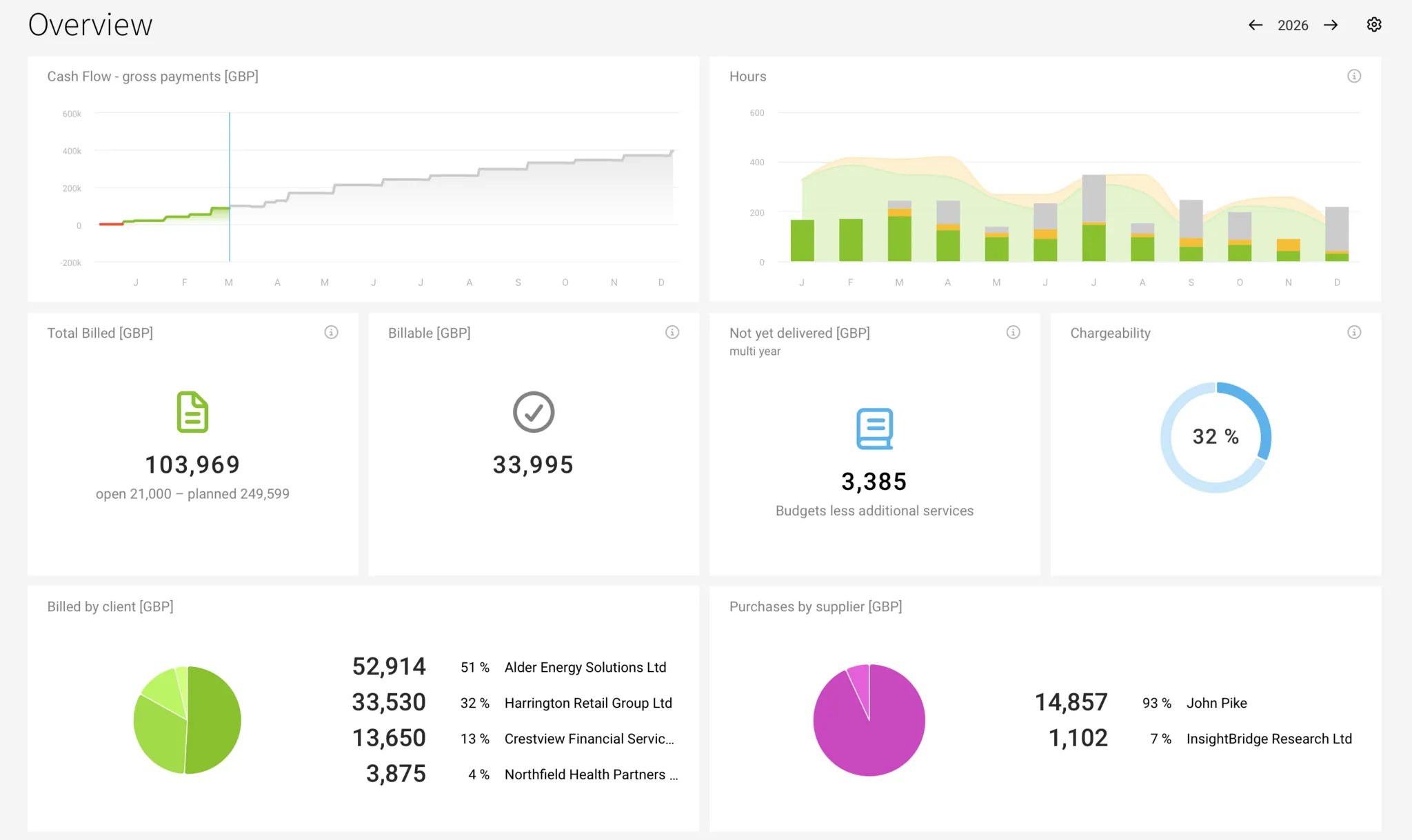
These tiles are shown by default
- Cashflow & liquidity planning: Income and purchases recorded and planned One click takes you to the detailed financial reports
- Hours: Planned and recorded project hours. Recorded absences are also shown.
- Total billed: Total of invoices created
One click takes you to the filterable invoice list - Billable: Planned services and services currently billable
- Not yet delivered: Shows what still needs to be delivered: “How many sold hours have not yet been delivered” (total project budgets minus the pro-rata additional service budget and hours already recorded).
- Billability: Billable hours in relation to target hours (from the employer’s perspective: all absences are taken into account except sickness – which has a negative impact).
.png "Einstellungen Dashboard") (English image not yet available)
(English image not yet available)More tiles you can choose from
Finance
- Income/Purchases: Shows the financial report in a compact format and links to it directly.
- Outstanding invoices: Shows total outstanding amounts and amounts by status, with direct links to the filtered lists. For example, one click takes you to the bulk action for the dunning run.
- Not yet billed: Compares the total of project budgets with the amounts already billed.
Invoices
- Billed by client: Existing tile from Finance > Overview, which is planned to be removed there in the long term. Shows the four clients with the highest invoice totals. Helps you identify any concentration risk.
- Incoming – gross payments: Tile from the Billing report. Shows monthly recorded and planned payments. Links to the cashflow report, which breaks down the payments. Recorded payments are also always available under “Billing” > “Payments”.
- Income: Tile from the Billing report. Shows created invoices and planned invoices, and can be tracked in detail via the linked financial report.
Purchases
- Purchases: Tile from the purchases report. Shows recorded and planned purchases by month. Also includes fixed costs (net). Use the tooltip on mouseover for a quick summary, or click the title for a breakdown of the individual items.
- Total purchases: Tile from the purchases report. Recorded purchases and how many of them are unpaid.
- Purchases by supplier: Existing tile under Finance > Overview, which is planned to be removed there in the long term. Shows the four suppliers with the highest purchase totals.
- Outgoing – gross payments: Tile from the purchases report. Shows monthly recorded and planned payments. Includes information on the breakdown via tooltip, plus a direct link to the cashflow report, which breaks down the payments. Recorded payments are also always available under “Purchases” > “Payments”.
- Purchases to be paid: Total purchases still to be paid (approved personal expenses claims and recorded incoming invoices).
- Remaining purchase budgets: Control for recorded purchase budgets. Shows the four pots with the largest volume, and groups all other budgets under “Other”.
Leads
- Weighted leads: Tile from the lead report. Shows the current volume in the sales pipeline calculated using probabilities, and shows the unweighted volume below.
- Weighted leads monthly: Tile from the lead report. Shows the probability-weighted volume per month. This requires a time period to be assigned to the lead.
- Closed leads:Compact info for Leads > Closed. Shows what volume was closed in the year. The close date is used.
- Lead volume monthly: Monthly forecast of lead volume. Display as under “Leads”, but here only for the relevant year.
Time Tracking
- Share of billable hours:Summarises the report under Reports > Time Tracking > Project Time. Shows how many billable project hours have been recorded compared to total hours.
- Working time irregularities
Have you enabled the irregularities view for working time tracking? The irregularities view gives both the person recording time and the overall report a clearer visual check for deviations from legal requirements. If an employee records time on a day of absence, this is also flagged. More about irregularities
People
- Open leave requests: Shows open leave requests and how many of them are assigned to you. Click the number to go straight to the list and review approvals.
- Next approved leave requests: Shows current and upcoming leave (from leave requests).
- Upcoming birthdays
Shows birthdays that have been saved. Click the title to go to the full birthday list in MOCO.
Whether you store birthdays in MOCO under People and Contacts is up to you (GDPR-relevant).
Finance: Overview
Location: Reports > Finance > Overview
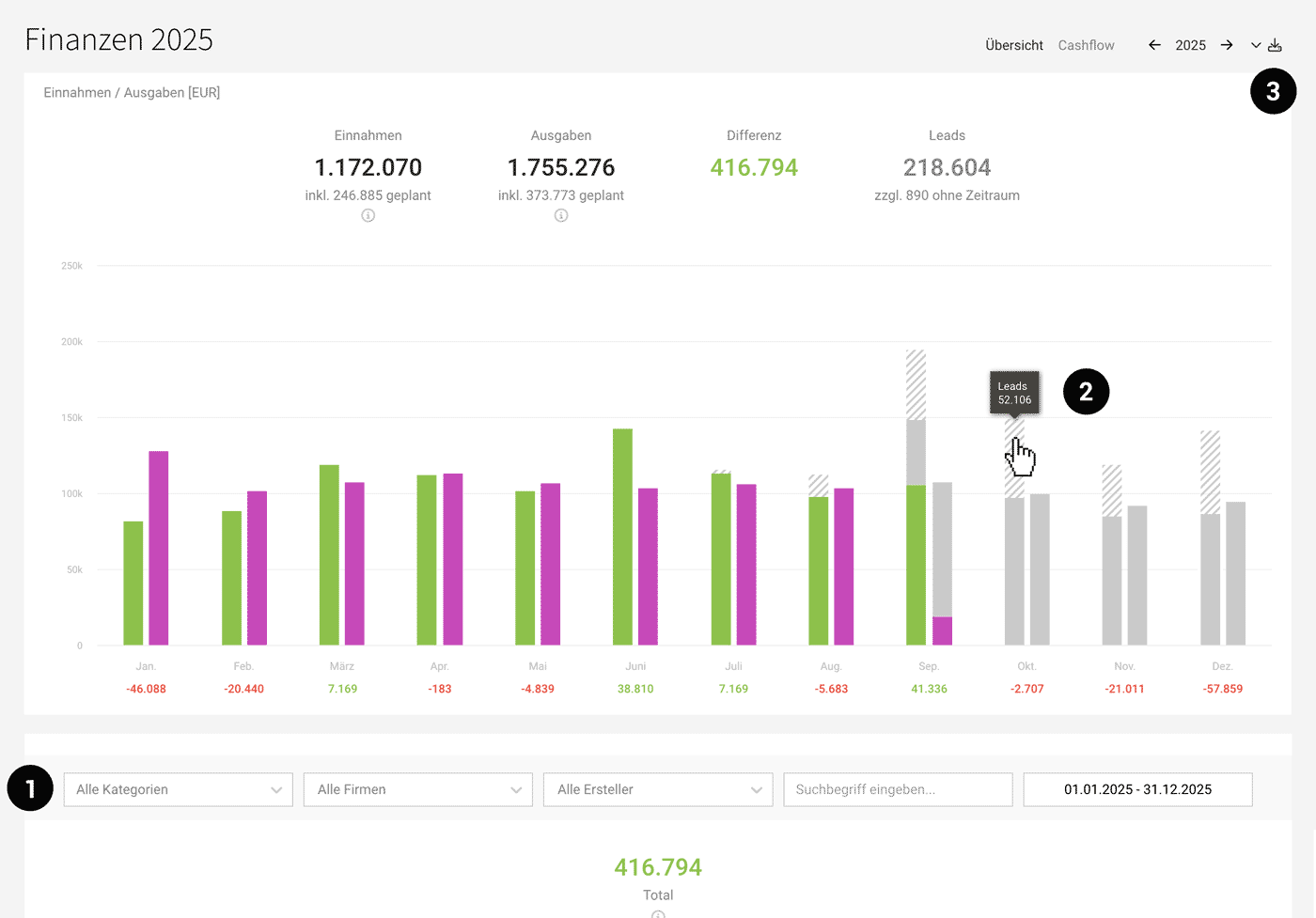
Purchases are compared against invoices. By breaking down the line items (1), you can, for example, identify missed planned billings or forecast revenue for a client.
 (English image not yet available)
Income
Green: All invoices (net) by invoice date, from status Created through to Paid.
Grey: Currently billable items and planned income
Hatched: Weighted lead volume with an assigned time period (2)
Hatched: Weighted lead volume with an assigned time period (2)
Invoices, Billable Items and Planned
Filterable via “Categories”. All amounts are net.
- Invoices (by invoice date)
- Invoices – Drafts (draft date, or if in the past: today)
- Hours (billable hours from projects by effort > end of month)
- Additional services (billable additional services > end of month)
- Planned income (planned billing > key date + planned hours > end of month) How to plan income
Purchases
Pink: Recorded purchases (supplier invoices, approved personal expenses, and fixed costs net)
Grey: Planned purchases (general purchases, planned project purchases, and future fixed costs – provided purchase planning is enabled)
Grey: Planned purchases (general purchases, planned project purchases, and future fixed costs – provided purchase planning is enabled)
Purchases and Planned
Filterable via “Categories”. All amounts are net.
- Purchases (by invoice date)
- Planned purchases (by planned date) How to plan purchases
- Fixed costs (as of the key date)
Tips & Info
- All Net If you have stored a tax rate for fixed costs, this report uses the net amount (otherwise gross).
- Click to filter in the chart (key figures, monthly figure, bars) or via categories, time period, etc. (1)
- i for detailed information
- Exports: targeted export of your filters + billable items per project and month (3)
- Billable items in the past are set to today’s date and carried forward, on the assumption they will be billed soon. If billing is not possible, you should mark open items as already billed or tick off billing plans.
- Use the compact tile in your Business Dashboard linked here.
Further Reports
Report under Billing
More information about the report under “Billing”
Reports under Purchases
Location: Purchases > Reports & Budgets
More information about the report under “Purchases”
More information about the report under “Billing”
Reports under Purchases
Location: Purchases > Reports & Budgets
More information about the report under “Purchases”
Finance: Cashflow & Liquidity Planning
Location: Reports > Finance > Cashflow
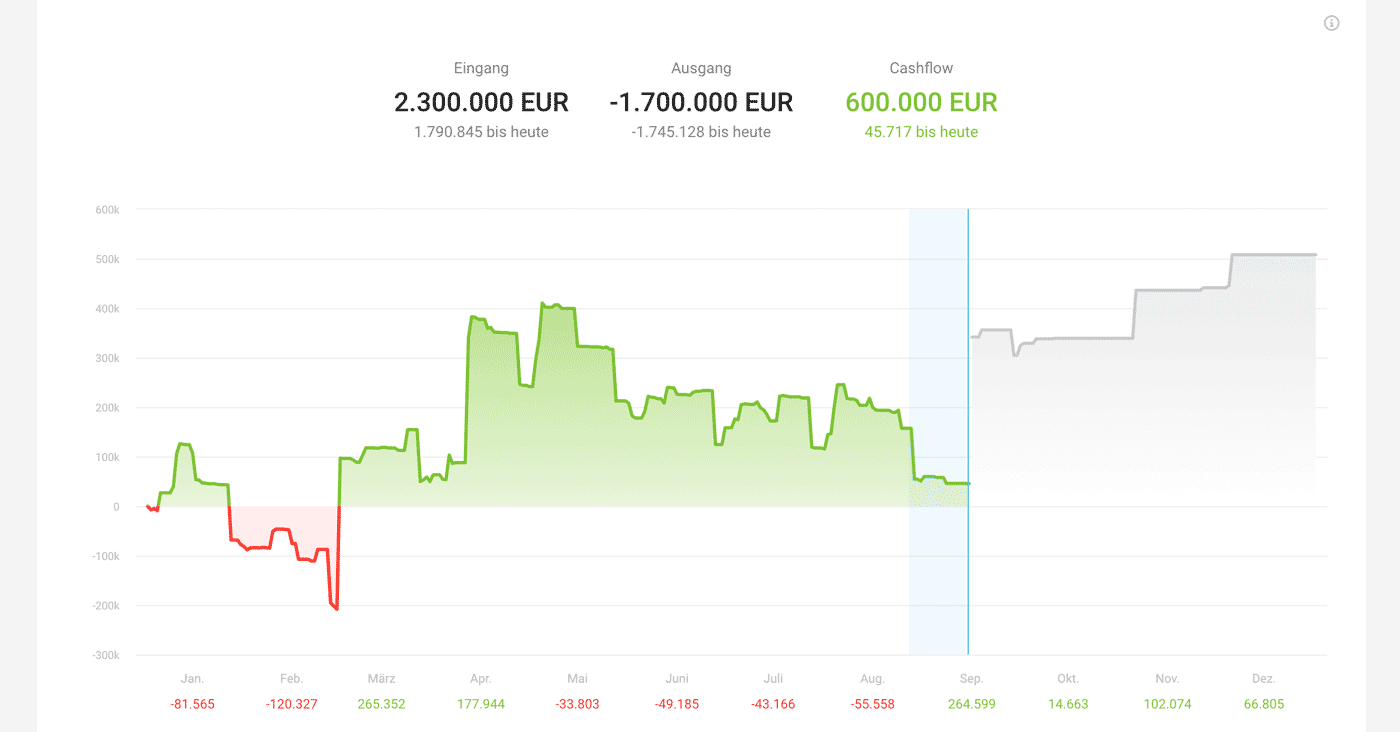
The "Cashflow" report shows all completed and planned payments. All amounts are gross (i.e. including tax).
 (English image not yet available)
.png "cashflow-liste") (English image not yet available)
(English image not yet available)Incoming
Filterable via "Categories". All amounts are gross (incl. VAT).
Income received + expected
- Payments (All recorded payments – see also Billing > Payments)
- Invoices (open) (Payable by)
- Invoices – Drafts (Draft date, or if in the past: today + payment terms)
- Hours (Billable hours from time & materials projects > end of month + payment terms)
- Additional services (Billable additional services > end of month + payment terms)
- Planned income: "Planned Billing" and "Planned Hours" from projects (depending on the billing type) > end of month + payment terms
Outgoing
Filterable via "Categories". All amounts are gross (incl. VAT).
Purchases made + expected
- Payments (All recorded payments – see also Purchases > Payments)
- Purchases (open) (up to the Payable By date)
- Planned purchases (on the Planned date + payment terms)
- Fixed costs (on the stored key date)
Tips & Info
- Breakdown via the chart
a) Period: Use your mouse to select a (particularly interesting or suspicious) period in the chart by dragging. The selected area turns blue (see the image above). The list shown below (1) then breaks down exactly that period.
b) Day: Clicking on a point filters all "events" for that day.
c) Figures: Clicking on the figures filters specifically for the related items. - Column sorting ascending and descending by clicking the column heading.
- "Days overdue" (2) shows how far apart the due date and the actual payment are. This is particularly helpful for paid invoices (clients’ payment behaviour) and open invoices.
- Export: You can easily export the filtered view in Excel format.
- To start with a specific amount, record a payment without an invoice under "Billing" > "Payments" > "+" (top right).
- To add billing plans to projects, use the smart filter "Without Billing Plan" in the project list.
- Add missing fixed costs and, if needed, enter the key date and tax rate.
- Automatic payment capture via bank connection or CAMT.
- If you don’t (yet) record incoming invoices in MOCO, you can store the total of (actual and planned) outgoing account movements under "Fixed Costs" to still assess your cashflow.
- Use the selectable, linked compact tile in your Business Dashboard.
Note: No payments, no cashflow
- If you don’t record any payments in MOCO, you can (e.g. monthly) set all outgoing or incoming invoices to paid with one click. This means the income is also visible in the cashflow chart. For incoming payments, automatic payment capture via bank connection or a CAMT file can support you.
Clients
Location: Reports > Clients
Revenue, effective hourly rate & profitability
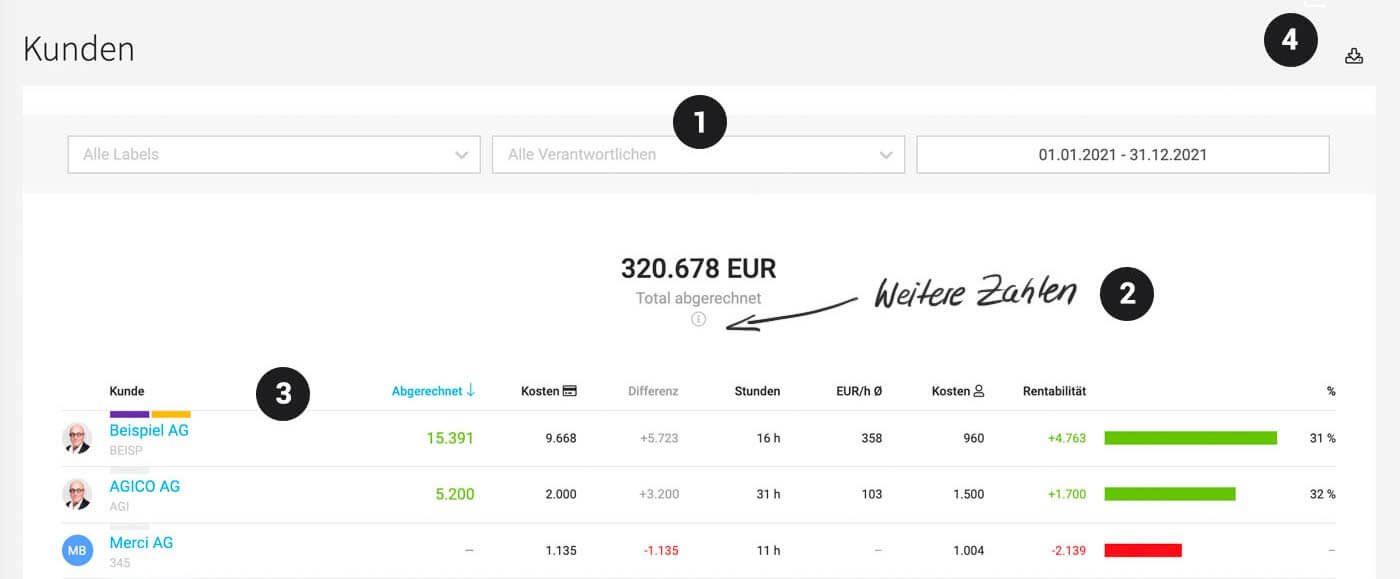 (English image not yet available)
- Use the Filter (1) to filter by labels, client owners, and an exact time period.
- The overall figure shows the total amount billed. Under the “i”, you can see additional overall figures (2).
- All columns (3) can be sorted in ascending or descending order; where it makes sense, the figures are linked.
- At the top right, use the Export (4) to create additional, tailored analyses if needed.
Projects
Location: Reports > Projects
Project profitability
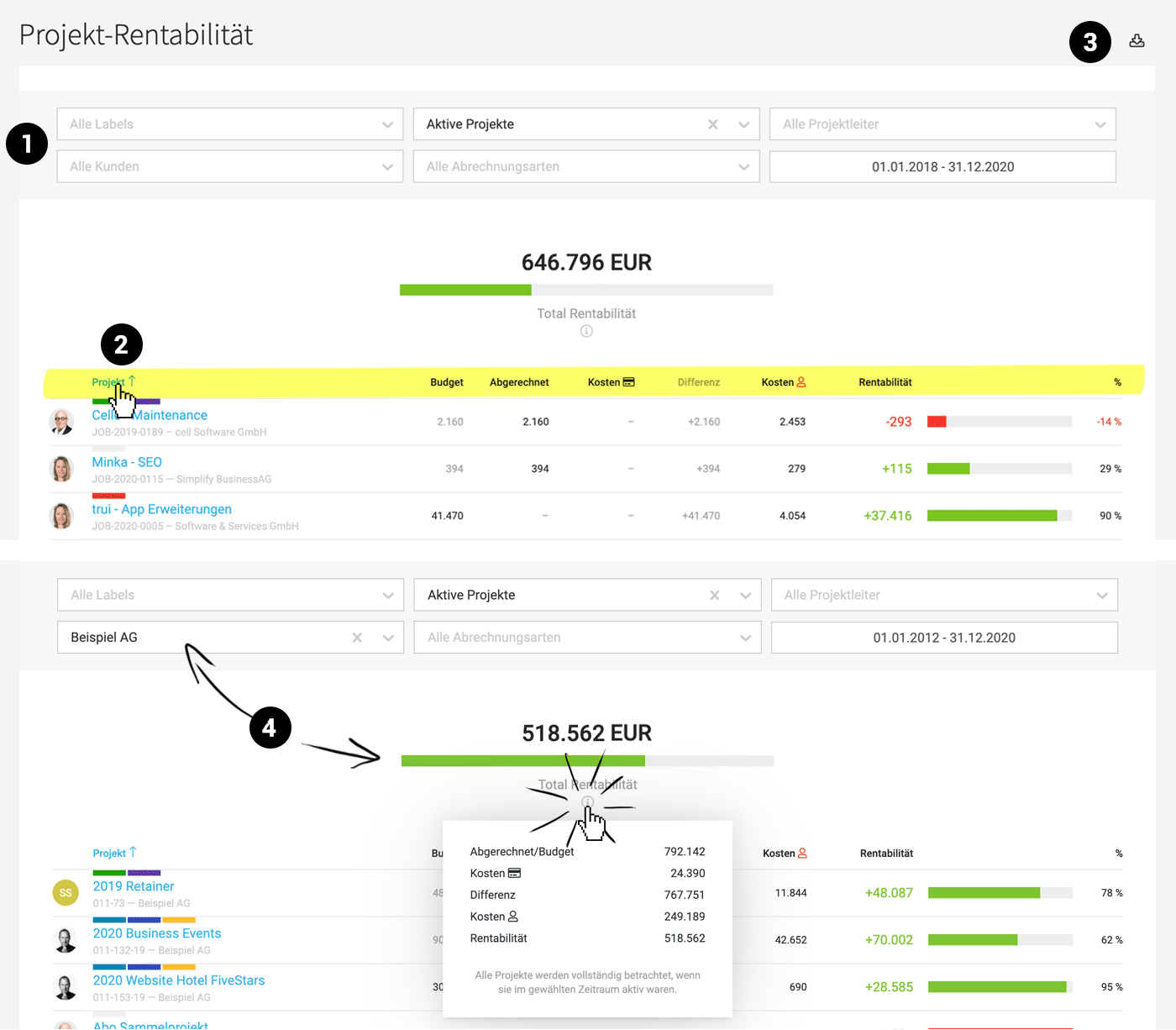 (English image not yet available)
Project profitability shows how far a project is in profit or loss, based on current costs. The filter (1) and sorting options (2) let you view the data in different ways.
Whole project period or day-by-day
By default, the project is viewed as a whole, but you can alternatively use the filter to narrow it down day by day. If the project has not yet been fully billed, the budget amount is used as the comparison value for the whole period. This default setting can also be disabled, so that only the amount actually billed is used.
- The columns can be sorted (1)
- The filter area offers various filter options, e.g. labels, billing type, and project management (1).
- Via the “i” below the overall profitability, you can access additional values (even after filtering) (4).
- The Excel export at the top right offers further analysis options (3).
---------------
Important: To make effective use of the two profitability reports (Projects and Clients)
Important: To make effective use of the two profitability reports (Projects and Clients)
- store the internal hourly rates in the settings (Settings > Account > Internal Hourly Rates). If the internal hourly rates are incomplete, the person icon turns red and a hover note is shown.
- record costs for additional services or assign purchases
---------------
Planning
Location: Reports > Planning
MOCO gives you an overview of utilisation/capacity, plus another view showing whether work was completed as planned.
Utilisation
The “Utilisation” report shows, at a glance, the monthly percentage team utilisation (1), as well as the hours not yet scheduled per person (2) and per team (3). The smaller the bar, the more fully planned it is.
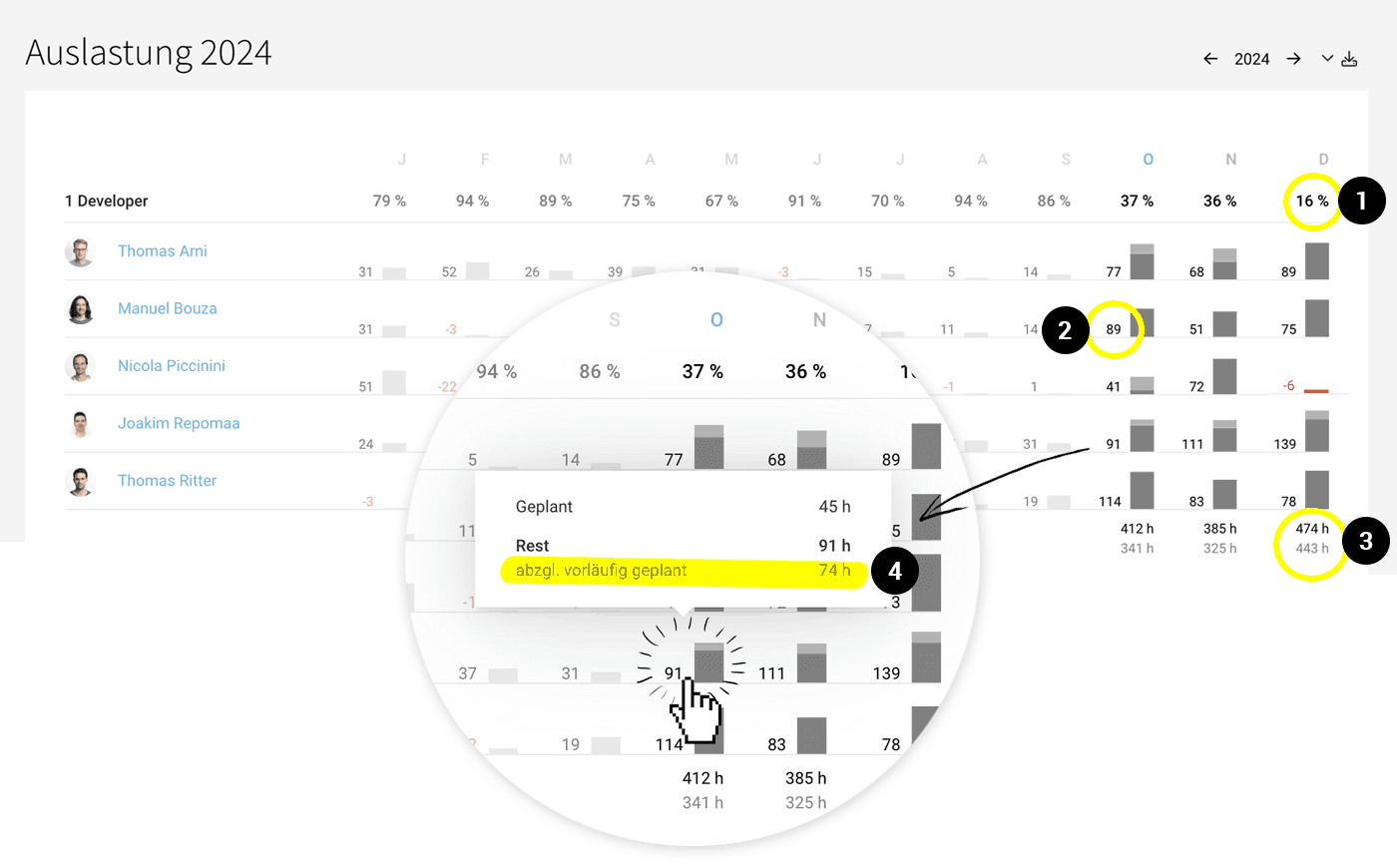 (English image not yet available)
Provisionally Planned Projects
You can see at a glance how many hours remain after deducting the provisionally planned hours, per team (3). For each person, provisional planning is shown by the light-grey bar. For more detailed information, use the tooltip to see how many hours remain after deducting the provisionally planned hours (4).
Reservations for Leads
Planned leads are also taken into account. The tooltip shows how the planning is broken down in detail.
Reservations for Leads
Planned leads are also taken into account. The tooltip shows how the planning is broken down in detail.
For more detailed data for your own analysis, use the Excel Export at the top right.
Displays While Planning
In Planning, you can see the following utilisation information per person:
- Utilisation for the next 4 weeks
- Number of hours not yet scheduled per week or day (depending on zoom level)
Completed / Planned
While “Utilisation” shows how far capacity has been scheduled, “Completed / Planned” also answers whether work was actually carried out according to plan. For each person, all planned and completed hours are listed for the selected period.
The metric at the top (1) shows at a glance, overall, whether work on planned projects matches what was planned. By default, the period (2) is set to the previous week.
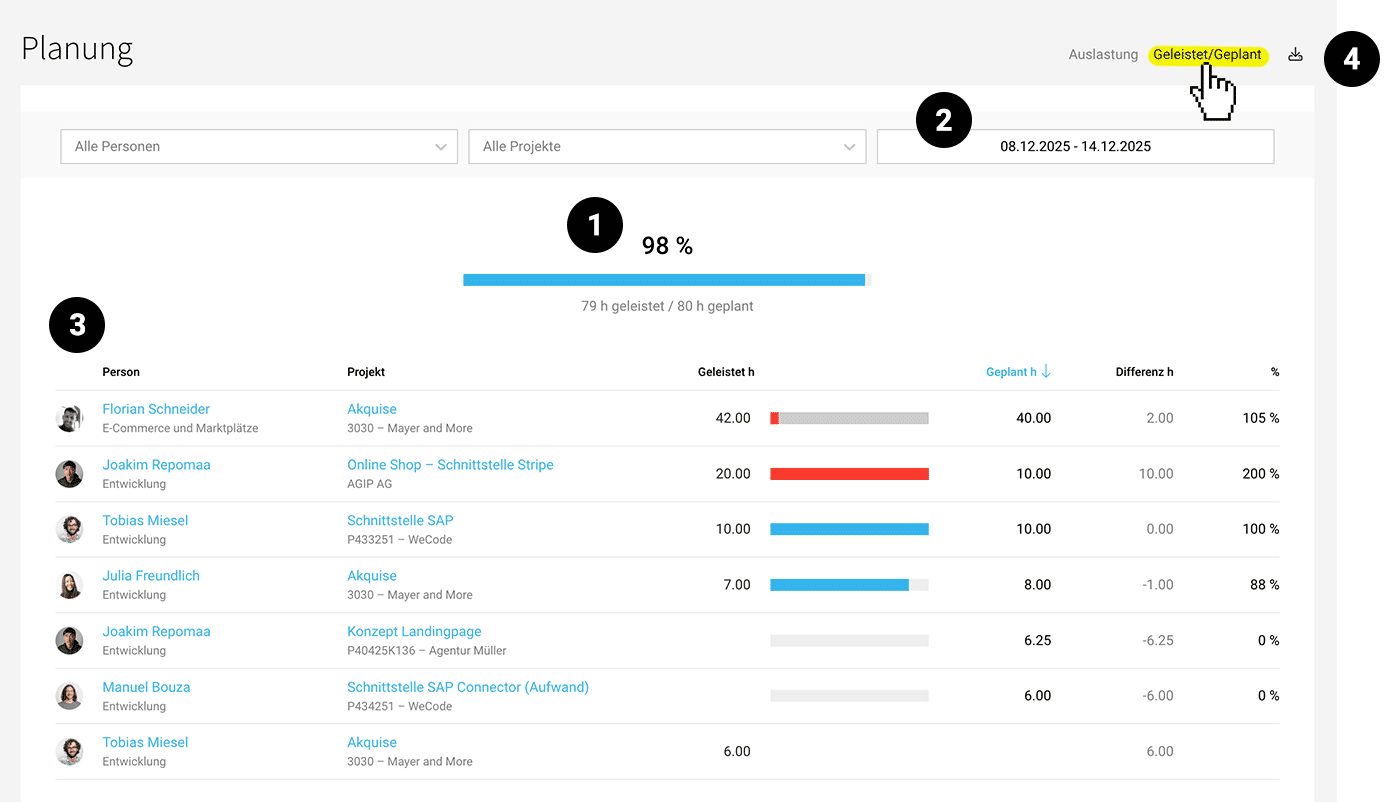 (English image not yet available)
The list (3) breaks this down and shows, per person and project: completed hours, planned hours, the difference between them, and the completion rate as a percentage (completed / planned). The bar visualisation makes it easy to scan.
If hours were logged against a project that was not planned in capacity planning, no bar is shown. These hours are also not included in the summary metric.
The metric at the top (1) shows at a glance, overall, whether work on planned projects matches what was planned. By default, the period (2) is set to the previous week.
(English image not yet available)The list (3) breaks this down and shows, per person and project: completed hours, planned hours, the difference between them, and the completion rate as a percentage (completed / planned). The bar visualisation makes it easy to scan.
If hours were logged against a project that was not planned in capacity planning, no bar is shown. These hours are also not included in the summary metric.
Use the filter (2) to narrow down by people and projects. You can also export (4) the filtered view as an XLS file.
Time Tracking
Location: Reports > Time Tracking
Overview, Project Time, Working Time
Overview, Project Time, Working Time
Overview
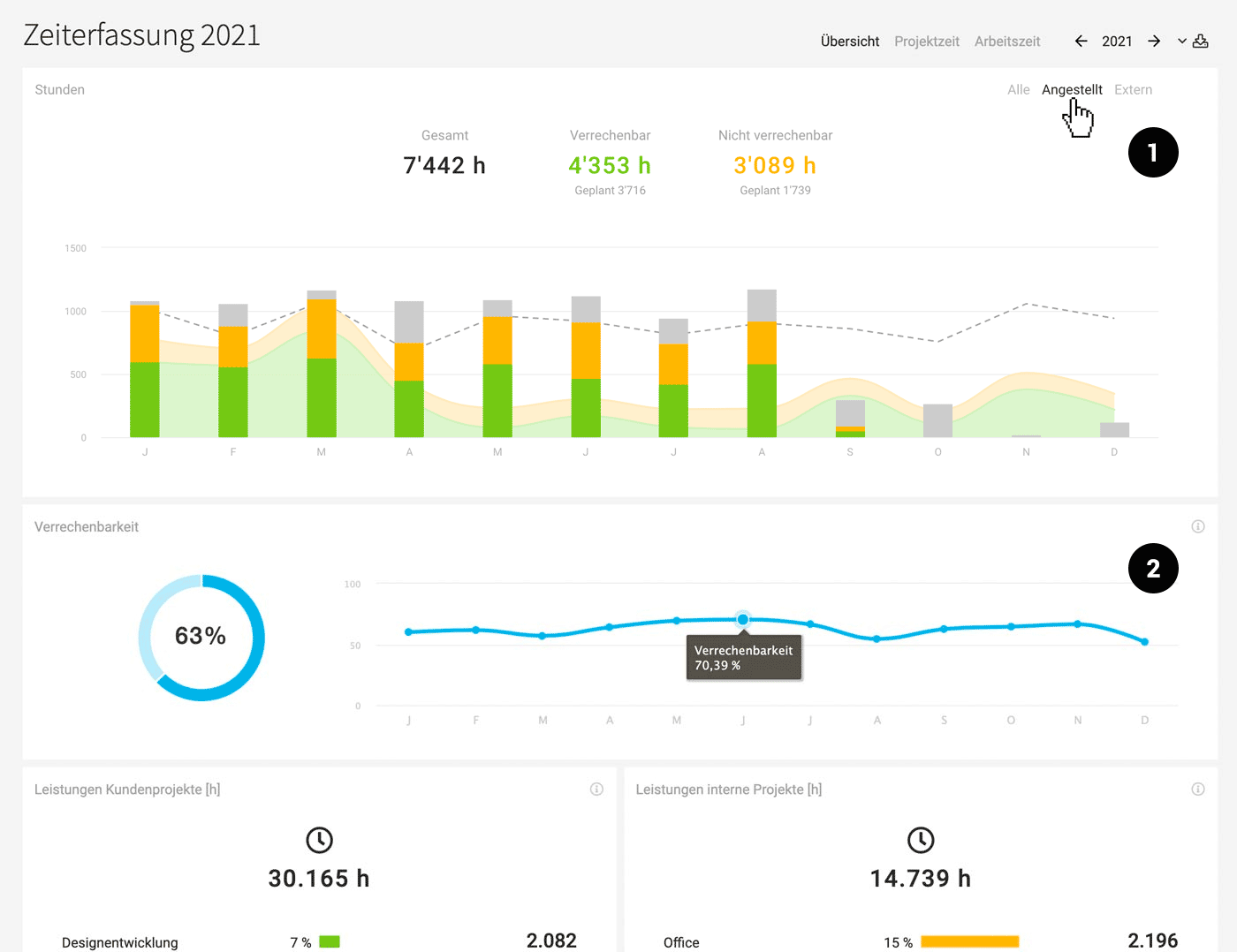 (English image not yet available)
Hours (1)
Total hours worked, monthly, billable, non-billable, vs. planned hours, vs. Target (when filtered by employee).
Billability (2)
Billability across the entire company, both total and monthly. A similar analysis is available in the Team Report and Personnel Report. (billable hours in relation to the Target – can be broken down via the export Reports > Personnel).
Services for Client and Internal Projects: Distribution of recorded hours across the services.
Project Time
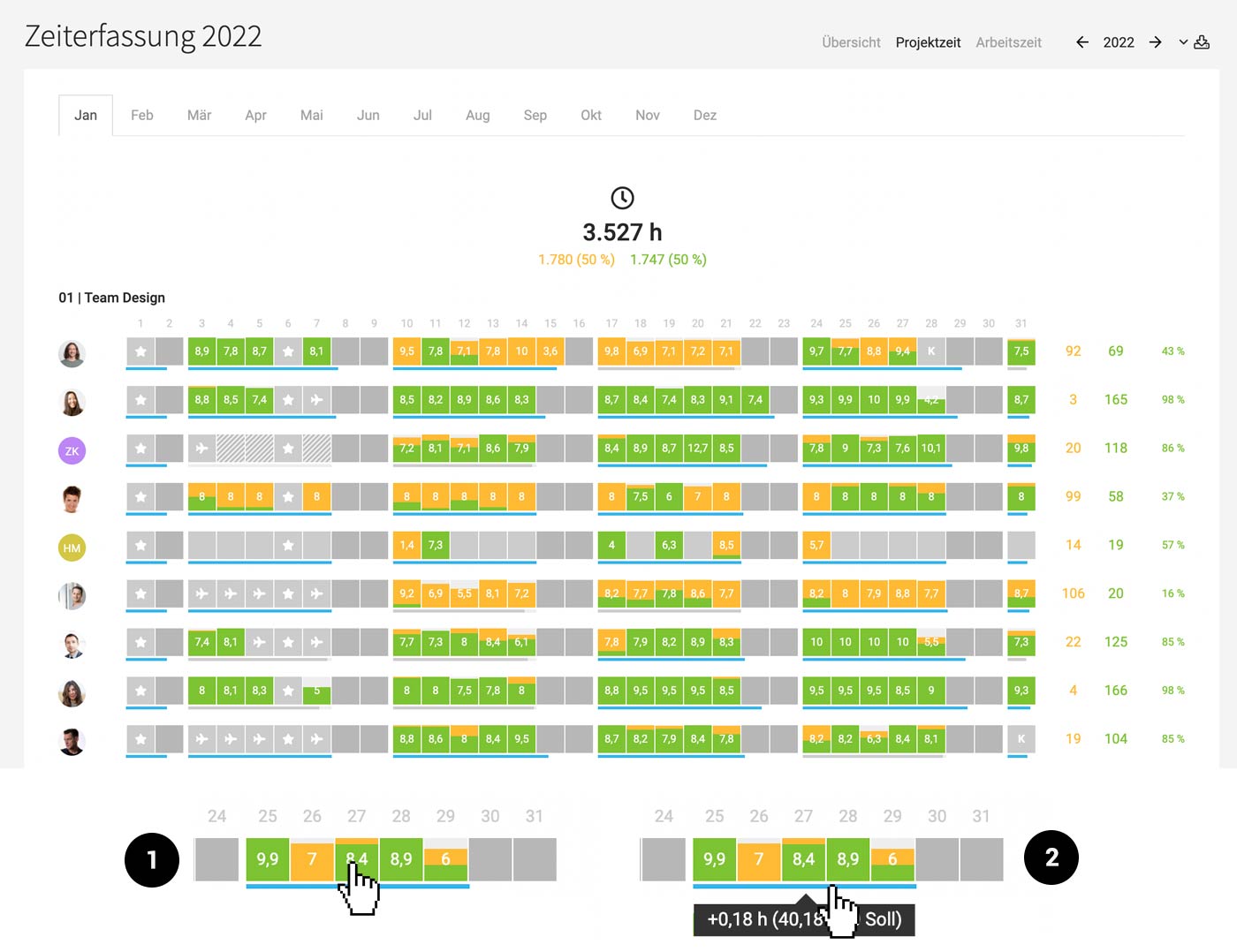 (English image not yet available)
The overview of time tracking across all employees
Clicking on a monthly bar in the company report "Hours" leads directly to this report.
Ratio of Billable and Non-Billable Hours
The illustrative representation of recorded billable and non-billable hours shows how they relate and develop – per person and across the team.
The illustrative representation of recorded billable and non-billable hours shows how they relate and develop – per person and across the team.
Details per Day
Clicking on a day provides the view of a Timesheet (1).
Weekly Target-Actual Comparison
Below each week, the progress bar is displayed, which is also available for each employee in the time tracking. It indicates whether the week's target has been reached or not. This allows for a quicker check if all hours have been logged.
Grey = Target not reached.
Blue = Target reached or exceeded.
Hovering over shows the detailed info (2).
Global Hour Export per Month and Year
There is an Excel export for personal evaluations at the top right.
Working Time
Overview of recorded working time per month, day, person. Displayed when working time tracking is activated for at least one person.
Clicking on the day (1) provides the details (2).
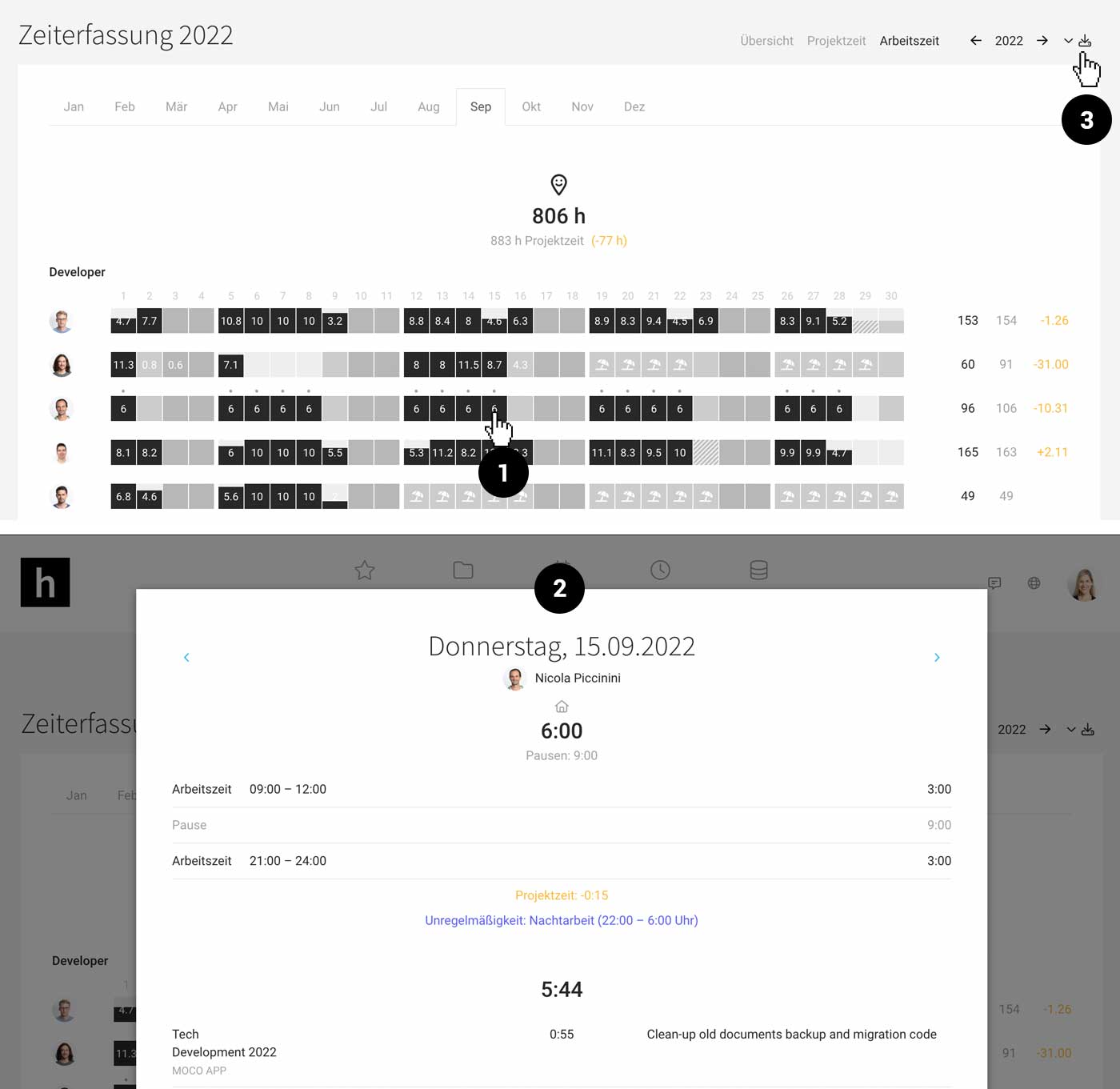 (English image not yet available)
Global Export (Excel) of Working Times (Excel) per month and year: top right (3).
If settings choose that the Target-Actual Comparison should be calculated based on working time, the progress bar will be displayed in this report.
Clicking on the day (1) provides the details (2).
(English image not yet available)Global Export (Excel) of Working Times (Excel) per month and year: top right (3).
If settings choose that the Target-Actual Comparison should be calculated based on working time, the progress bar will be displayed in this report.
Personnel
Location: Reports > Personnel
Target-Actual & Billability
Target-Actual per person and month, total balance
Billability per person and year
Export at the top right with comprehensive content
Billability per person and year
Export at the top right with comprehensive content
Leave
Leave days per person and month, total balance
Sick days per person and year
Export at the top right
Sick days per person and year
Export at the top right
Absences
Filterable and sortable list per person and month, total balance
All types of absences per day with traceable comments
Export (pre-filterable) at the top right
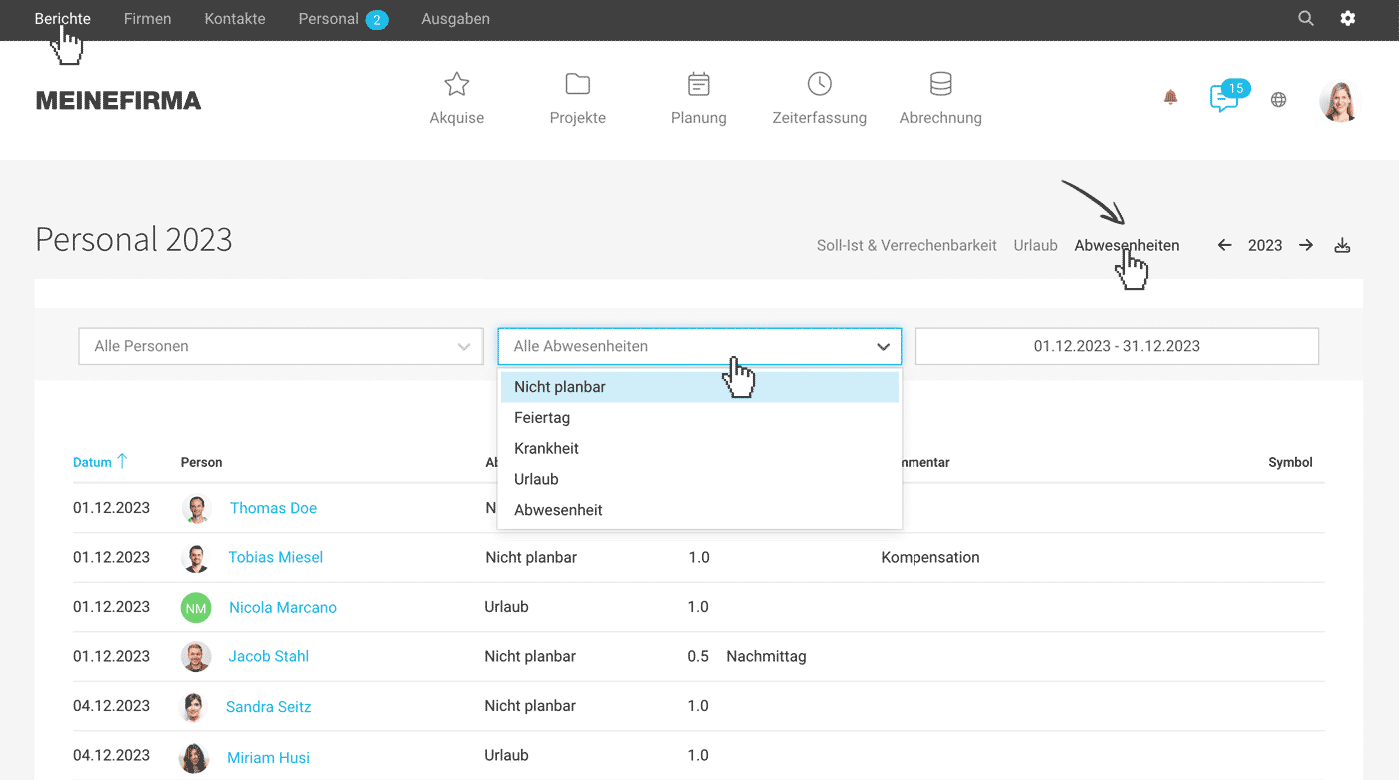 (English image not yet available)
All types of absences per day with traceable comments
Export (pre-filterable) at the top right
(English image not yet available)Leads
Location: Acquisition > Leads > Report
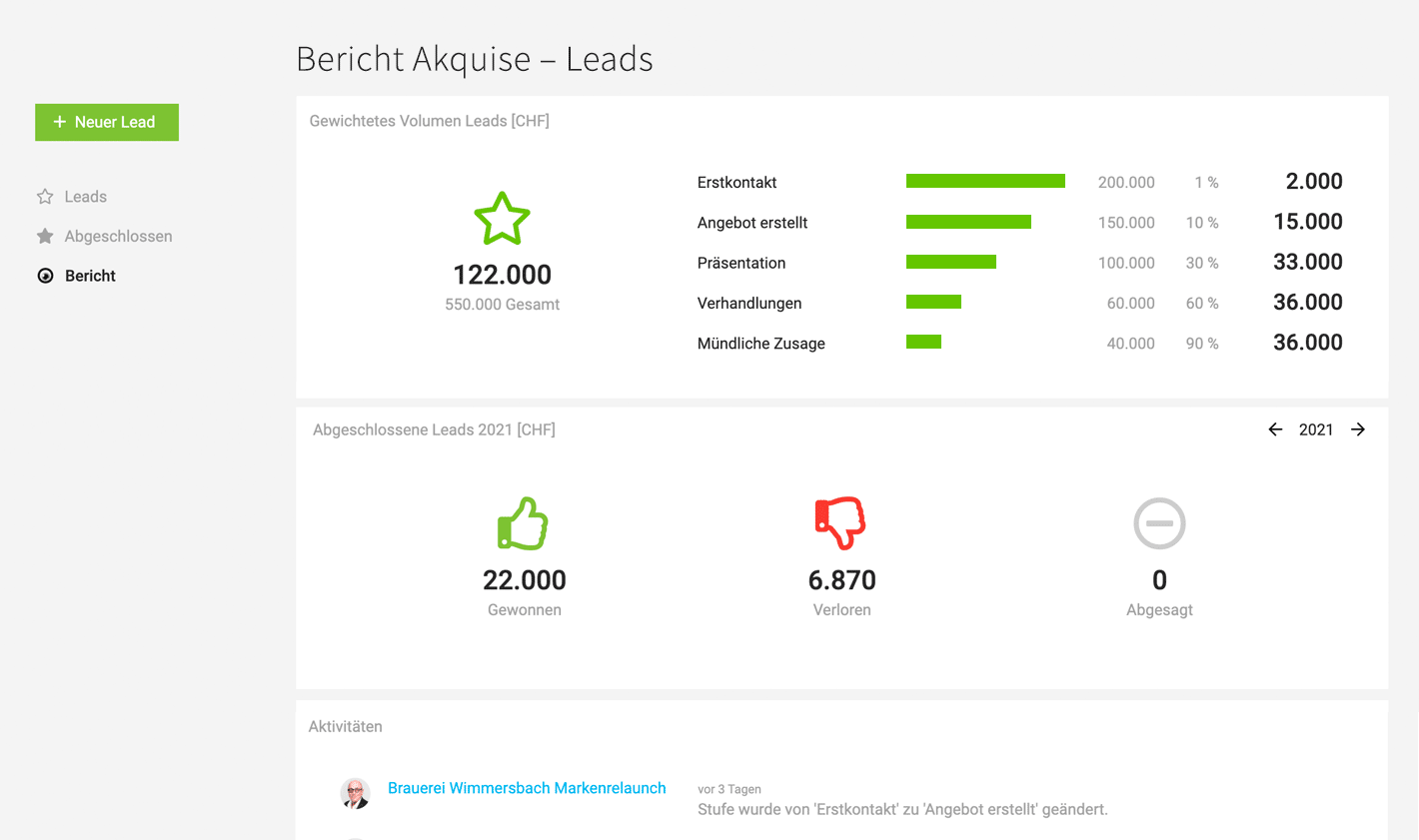
Report on future revenue in the pipeline and sales activities.
Total and weighted lead volume
Acquisition stages displayed as a sales funnel with proportional volumes
Completed leads won vs. lost or cancelled
Activities provides a concise overview of recent sales activities.
 (English image not yet available)
Report on future revenue in the pipeline and sales activities.
Total and weighted lead volume
Acquisition stages displayed as a sales funnel with proportional volumes
Completed leads won vs. lost or cancelled
Activities provides a concise overview of recent sales activities.
(English image not yet available)