Data Import, Data Migration, Layout.
Ready for the start with MOCO? Find out here how to pragmatically migrate your existing data into MOCO and adapt the layout of quotes, invoices, etc. to your corporate design.
Import Companies, Contacts and Leads
You can import companies, contacts and leads directly in the app as an Excel file – using our template or intelligently with the help of AI. We recommend testing the import with a small data set first. How to migrate further data such as projects or invoices, if needed, is described below.
The order of imports matters, since some data builds on other data. Start with companies, then add contacts, and finally upload potential leads to MOCO.
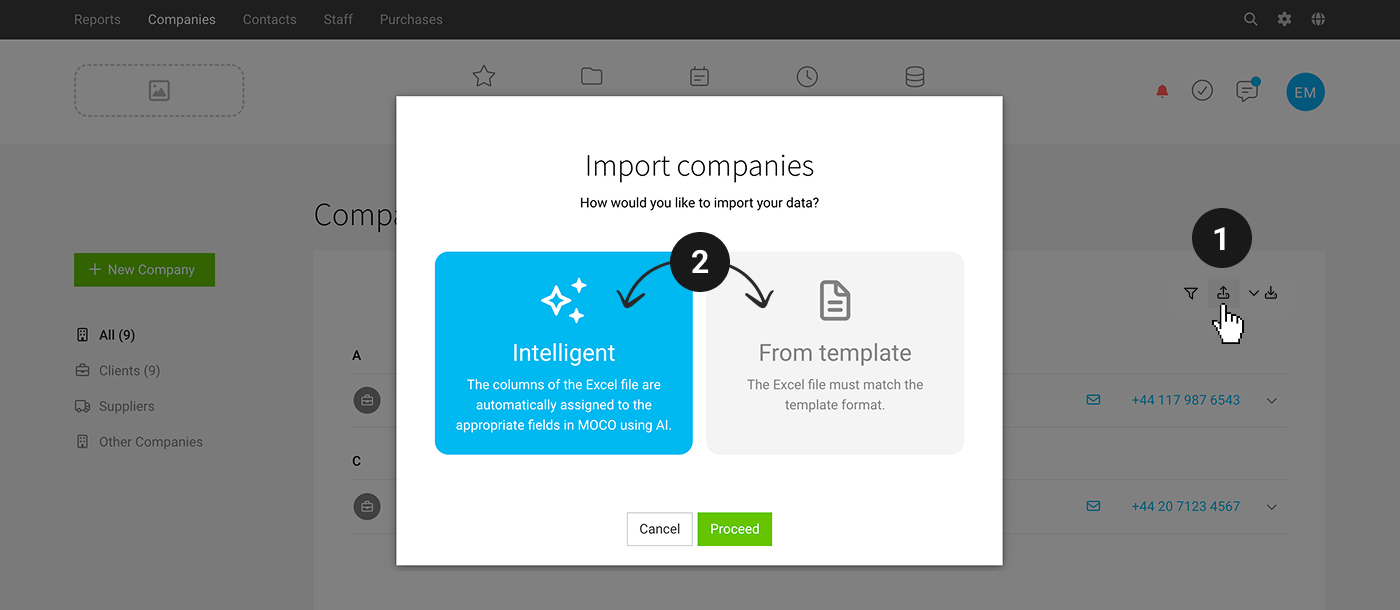
1. Companies
Under "Companies", top right, click the import icon (1) to import clients, suppliers, and other companies (format: Excel). Private individuals who are a client or supplier are also grouped under the umbrella term "Companies" in MOCO. In the second step, choose whether you want to import the data intelligently with AI, or prepare it according to our template (2).
2. Contacts
Similar to companies, you can import contact persons under "Contacts", top right (format: Excel). Contacts are automatically assigned to existing companies if the stored company name matches exactly.
3. Leads
Just like companies and contacts, there is also an import option under "Leads", top right. However, this import is only available via AI and may first need to be activated under Settings > Account > AI
Good to Know
Custom Fields: If you want to import your own data fields, create the Custom Fields in MOCO beforehand, and make sure the Excel column has exactly the same name during import.
Incorrect Data MOCO marks imported records with a label. Use it to check whether companies, contacts, and leads were created correctly, and simply delete imported data again if needed.
Migrate Further Data
Projects, invoices, and other data generally do not need to be imported. Instead, only migrate what is really important and essential for day-to-day business, for example
- via the MOCO API,
- with AI via the MCP interface.
Projects
As a rule, it only makes sense to record ongoing projects. To do this, add hours retrospectively as a single time entry per person (more than 24 h in one day is possible), and, for reference, upload a timesheet to date to the project as a file. Alternatively, store an additional service such as "Carryover" or similar on the project.
Recreate Individual Invoices
To have all invoices issued so far in the current year in MOCO as income as well, you can roughly recreate the invoices on the client or the project.
For traceability, we recommend:
- Name the invoice number to match the original invoice (temporarily set number ranges to "manual" for this).
- Clearly indicate in the title that this is not the original invoice (e.g. "RECREATED").
- Optionally upload the original document as an attachment – it will then be integrated directly into the document PDF.
So that payments also appear as income in the cashflow
All invoices for a month can be selected in the list under "Billing" and set to paid for the relevant month via the bulk action at the bottom left.
To prevent invoices from being marked as "overdue", set them to "ignored".
Show Income Only
If you start using MOCO part-way through the year and want to visualise income and expenses (gross) for the cashflow from previous months, enter the monthly amount in the relevant area under "Payments" > "+" > "Payment Without Invoice".
Import Service
On request, we offer a data import service. Anything that could previously be exported from the other system – such as Spirit, Revolver, Troi, Rodeo, HQ, Harvest, or Mite – in tabular form (XLS or CSV) can be imported. Based on experience, costs range between 400.– and 1600.– and depend significantly on the scope and quality of the data.
Contact our support team for more information on the process.
Set Up Layout
In MOCO, you can set up your invoice and quote layout quickly and easily yourself. The formatting you choose applies consistently across all documents.
To do this, go to » Settings Under "Layout" and ideally proceed as follows:
2. Upload Your Own Fonts If Needed
3. Choose Margins and Formatting
4. Review Further Settings Options
Note: After layout changes, open documents that have already been created and save them again if they should adopt the new layout.