Review & Complete
Incoming Invoices | Assign Project | Invoice Approval | Payments | LabelsIncoming Invoices
Purchases > Incoming
The digital incoming invoice system collects all purchase receipts. The workflow requires that all items in the inbox are completed and then moved to the archive. The accounting export is independent of this.
The Inbox Zero Principle
The "Inbox" is your to-do list that needs to be completed. The goal is to reduce the inbox to zero. Incoming invoices arrive as drafts (grey) and are reviewed by you to be created as a purchase.
Complete and Move to Archive
At the time of invoice entry, information such as "Can the invoice be assigned to a project?" is often missing, or the receipt is insufficient. Once all necessary points for the respective purchase are checked off, it is moved to the archive.
Points to Check Depending on the Purchase
✅ Receipt recorded?
✅ Supplier recorded? (not necessary for small invoices like taxi rides, restaurants, groceries, etc.)
✅ Approval granted? (Approval process optional)
✅ Approval granted? (Approval process optional)
✅ Payment recorded? (only then is the gross amount considered in the cash flow)
✅ Assigned to a project or planned purchase? (Assignment)
✅ Budget selected? (Budgets or cost centres)
✅ Category assigned? (Categories/Expense accounts)
✅ Budget selected? (Budgets or cost centres)
✅ Category assigned? (Categories/Expense accounts)
Smart Filters Assist in Completion
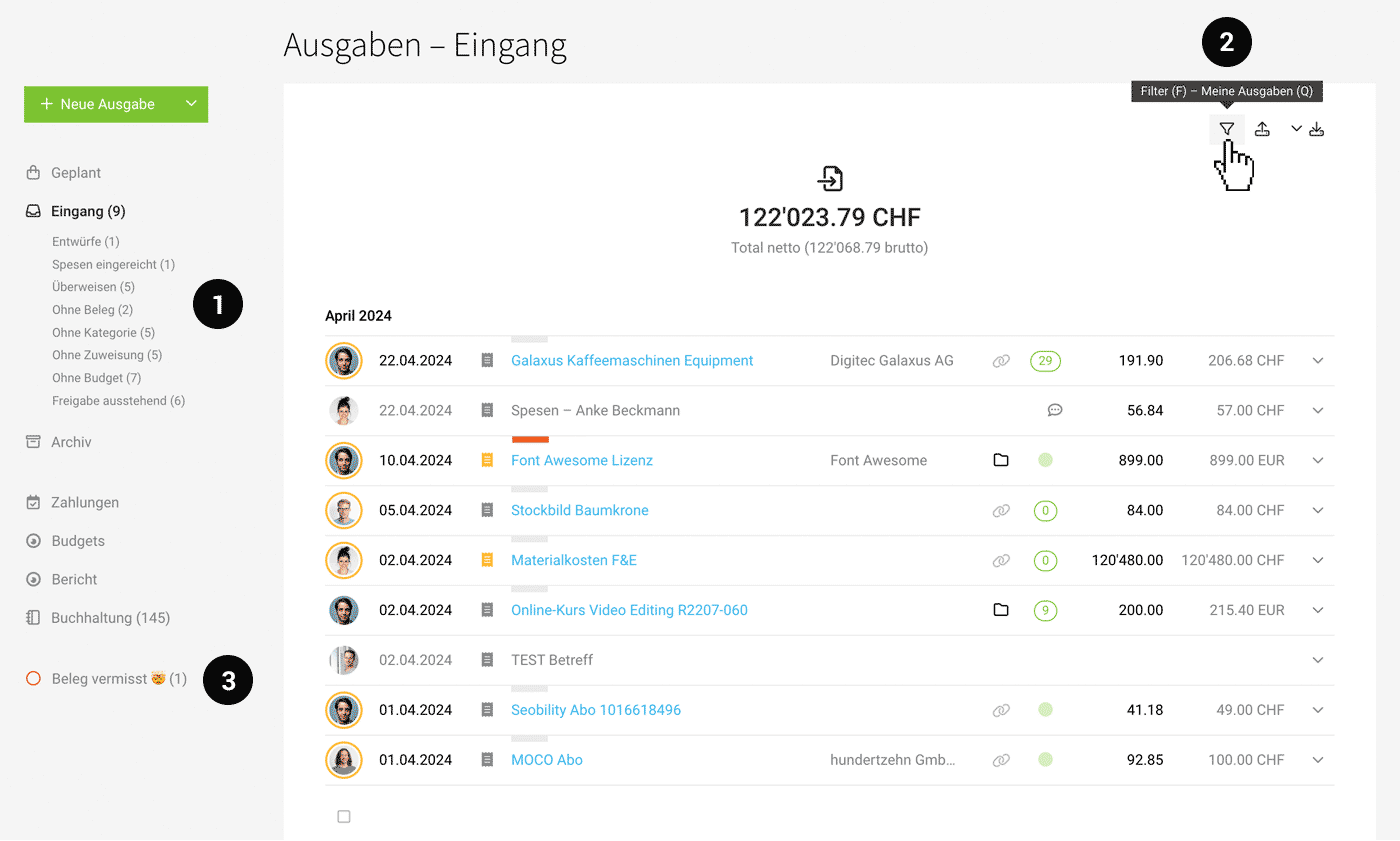
MOCO uses Smart Filters (1) to highlight anything unfinished. The relevant purchases can be accessed with a single click.
 (English image not yet available)
(English image not yet available)Standard Filters & Labels
- The standard filter (2) is also accessible via keyboard shortcut "F". Use keyboard shortcut "Q" to filter the list for all purchases where you are assigned as the responsible person.
- Customizable Labels (3)
Drafts & Personal Expenses
Bild Digital-Incoming-Invoice-Completion konnte nicht geladen werden!
Automatically recorded receipts await review in the inbox as drafts
With a click on the Smart Filter "Drafts" (1), you can filter for all purchases that have arrived but have not yet been recorded. With activated AI text recognition (OCR), drafts are already read with the amount. By reviewing the data, you create the purchase. Use "Save + Next" to process all drafts directly.
If you have enabled personal expense recording for your employees, submitted personal expense reports also await approval here. With approval, the company purchase is created.
- With a click, you can filter using the Smart Filter "Personal Expenses" (1).
- After approval, you can reimburse the amount to the employee via the transfer order
Assign Project
Assign a Purchase to a Project
Recorded purchases/supplier invoices can be assigned to a project from the list by clicking the link icon (see image). For recharging (you can choose the document as an attachment) and/or cost tracking. In the project, the purchase is linked and traceable.
 (English image not yet available)
Using the Smart Filter "Unassigned", you can see all purchases that have not yet been assigned with a single click. If you want to exclude specific ones from being assigned straight away, select them and then choose the bulk action "No Assignment" at the bottom.
(English image not yet available)Using the Smart Filter "Unassigned", you can see all purchases that have not yet been assigned with a single click. If you want to exclude specific ones from being assigned straight away, select them and then choose the bulk action "No Assignment" at the bottom.
Assign to an Existing Additional Service
When assigning the purchase, select the project and the additional service (e.g. already carried over from the quote). The costs for the additional service are updated and the document is stored. The (sales) price that has already been set does not change.
- For the additional service to be offered, purchase assignment must be active.
- Select "Assign & Close" if no further purchase items are to be assigned. This deactivates purchase assignment. As our analysis shows that over 90% of additional services only have one purchase assigned, this is the primary action. This saves you the step of selecting "Purchase assignment inactive" for the additional service in the project. Select "Assign" if purchase assignment should remain active. You can then assign further purchases.
Define Your Default Behaviour
Whether purchase assignment is set to active or inactive for newly created additional services can be predefined under Settings > Projects.
Example: flat-rate expenses:
An additional service with a fixed price is created in the project (it can be carried over from the quote in advance). All related costs from personal expenses and supplier invoices are then assigned. The costs add up, and the documents are collected. At the end, this line item can be included on the invoice as created, but it does not have to be.
Planned Purchase
If you use purchase planning, you can also plan the project purchase for your business (forecast) via the additional service and control the assignment of the supplier invoice. More about planned purchases
Whether purchase assignment is set to active or inactive for newly created additional services can be predefined under Settings > Projects.
Example: flat-rate expenses:
An additional service with a fixed price is created in the project (it can be carried over from the quote in advance). All related costs from personal expenses and supplier invoices are then assigned. The costs add up, and the documents are collected. At the end, this line item can be included on the invoice as created, but it does not have to be.
Planned Purchase
If you use purchase planning, you can also plan the project purchase for your business (forecast) via the additional service and control the assignment of the supplier invoice. More about planned purchases
Create a New Additional Service (Automatically)
When assigning, you can also have the additional service created automatically in the project. In this step, the person responsible for the project is notified, unless they have disabled this in their Profile Settings for Notifications.
By creating an additional service, you book a new service directly to the project. The purchase is linked in a traceable way. This link records the costs (purchase price) and the document, as well as the price (sales price to the client). This can be adjusted later in the project. If you prefer a general mark-up directly during assignment, you can define this in Settings.
By creating an additional service, you book a new service directly to the project. The purchase is linked in a traceable way. This link records the costs (purchase price) and the document, as well as the price (sales price to the client). This can be adjusted later in the project. If you prefer a general mark-up directly during assignment, you can define this in Settings.
Assign a Purchase to Multiple Projects
You can also record multiple line items for a purchase and assign them to different projects.
Assign Multiple Purchases to an Additional Service
You can assign multiple purchases to an additional service that has already been created (e.g. the flat-rate expenses line item).
Undo an Assignment
a) On the purchase, via the unlink icon
b) In the project, select "Remove Purchase" (dropdown in the list of additional services, or the unlink icon in the detail view). This only removes the assignment. Alternatively, delete the additional service entirely in the project.
The purchase line item can then be assigned again.
Tip to reduce clicks: On the purchase, hold down the cmd (Apple) key and click the project name. This opens the project in a new tab. Make your changes, close the tab, then back on the purchase briefly reload the page.
b) In the project, select "Remove Purchase" (dropdown in the list of additional services, or the unlink icon in the detail view). This only removes the assignment. Alternatively, delete the additional service entirely in the project.
The purchase line item can then be assigned again.
Tip to reduce clicks: On the purchase, hold down the cmd (Apple) key and click the project name. This opens the project in a new tab. Make your changes, close the tab, then back on the purchase briefly reload the page.
No Assignment
If certain purchases should not be assigned, you can set them to "No Assignment". They will then also be excluded from the Smart Filter "Unassigned", which highlights purchases that have not yet been assigned.
Invoice Approval
Requesting invoice approval is optional. For higher amounts, you can set up an automatic approval request, and otherwise request approval for individual invoices as needed. Here’s how the approval workflow works:
Request Approval
Set up automation from a minimum amount
In Settings, you can define the amount from which a specific person must automatically approve the purchase.
Request approval for a specific invoice
You can initiate invoice approval either on the invoice detail page (1a) or from the list via the dropdown (1b).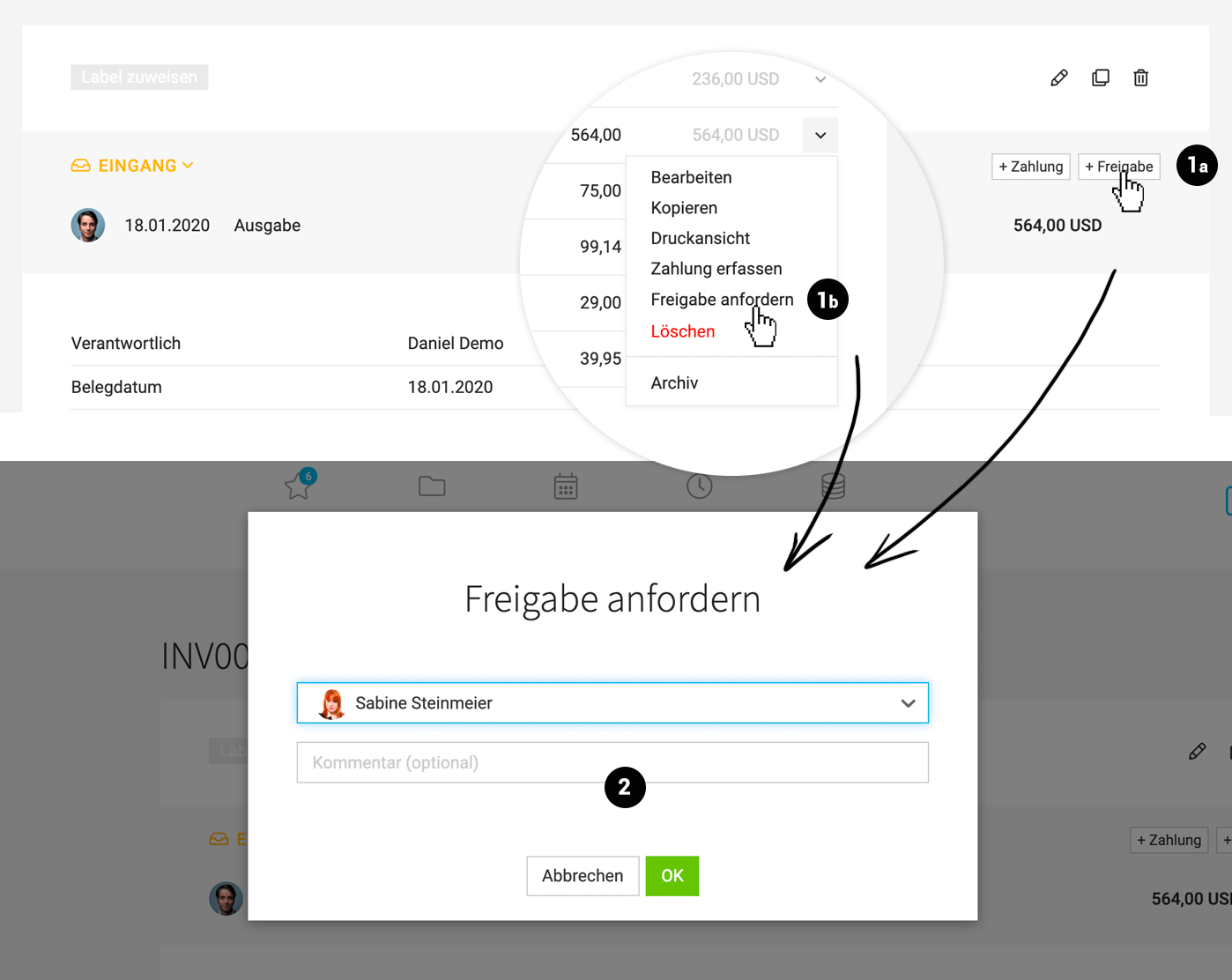 (English image not yet available)
In Settings, you can define the amount from which a specific person must automatically approve the purchase.
Request approval for a specific invoice
You can initiate invoice approval either on the invoice detail page (1a) or from the list via the dropdown (1b).
(English image not yet available)→ You can address anyone with full access or restricted access to purchases.
→ The purchase is highlighted in orange in the list.
→ You can filter specifically for pending approvals using the new Smart Filter (3a).
→ With a comment (2), you can explain what you need approval for, e.g. checking the invoice or assigning it to a project for re-invoicing/cost tracking.
→ With a comment (2), you can explain what you need approval for, e.g. checking the invoice or assigning it to a project for re-invoicing/cost tracking.
The Person You Addressed Is Notified
The person you addressed is made aware of the newly requested approval in various ways:
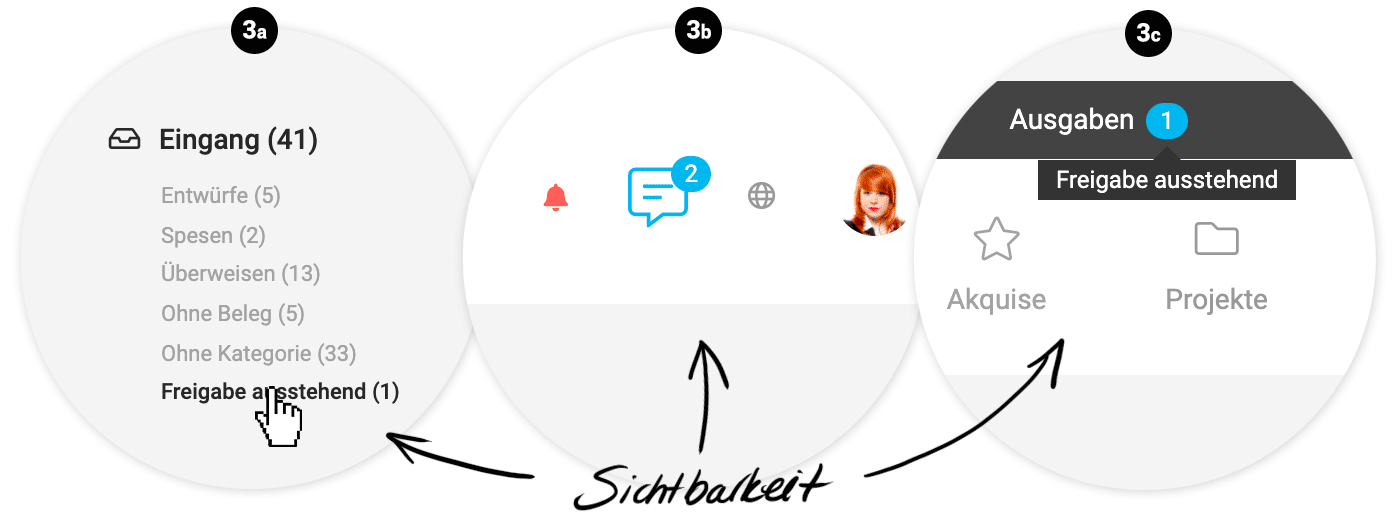
→ They receive a message with the comment (notification options can be set in their profile). It links to the purchase (3b).
→ The number of pending approvals assigned to a person is shown via the "blue pill" (3c) . Clicking it filters directly to these, so it has the same effect as the shortcut "Q" mentioned in the next point.
→ You can also use the Smart Filter to filter for requested approvals (3a). The keyboard shortcut Q reduces the list to your own.
 (English image not yet available)
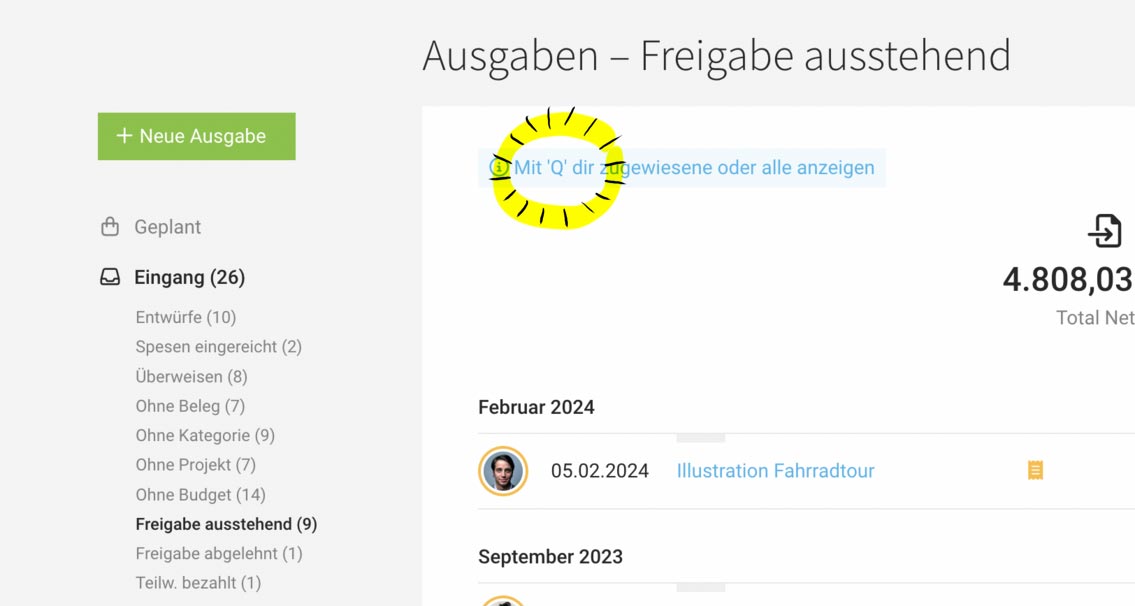 (English image not yet available)
→ They receive a message with the comment (notification options can be set in their profile). It links to the purchase (3b).
→ The number of pending approvals assigned to a person is shown via the "blue pill" (3c) . Clicking it filters directly to these, so it has the same effect as the shortcut "Q" mentioned in the next point.
→ You can also use the Smart Filter to filter for requested approvals (3a). The keyboard shortcut Q reduces the list to your own.
(English image not yet available)(English image not yet available)Approve or Reject
The person you addressed checks the invoice and can select "Approve" at the top of this detail view (4).
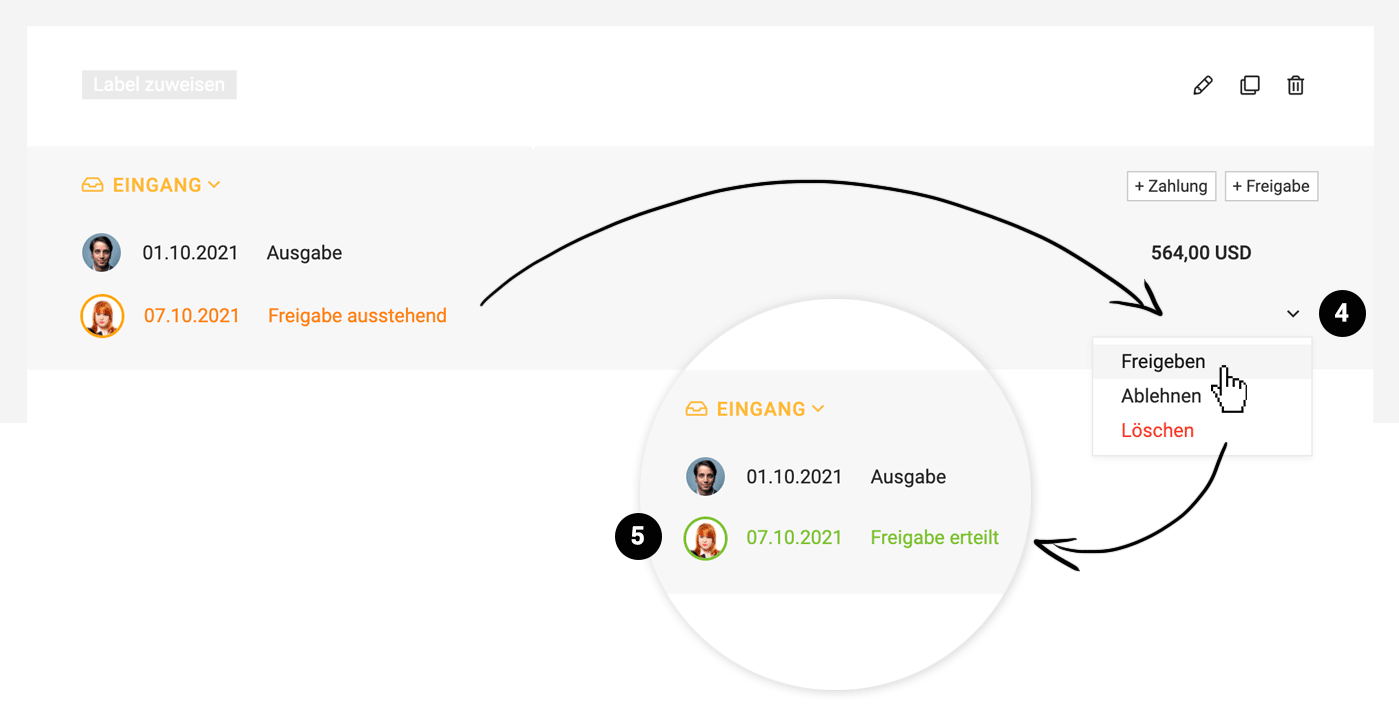 (English image not yet available)
→ Only the person you addressed can do this. The approval takes effect immediately and usually does not require any further comments. If needed, a comment can be left below the invoice, or another person can be notified.
→ The purchase is marked with a green circle in the list (5).
→ The requester is notified of the approval.
Reject approval / wrong contact person / delete approval request
→ The person you addressed can select "Reject" (4) and enter a reason/comment. The requester is notified accordingly and can request a new approval from someone else.
→ If the person you addressed wants to let you know they are the wrong contact person, they can do so below via a notification.
→ A requested approval can be deleted at any time by anyone with full access to "Purchases".
MOCO documents the steps in the history below the invoice.
(English image not yet available)→ Only the person you addressed can do this. The approval takes effect immediately and usually does not require any further comments. If needed, a comment can be left below the invoice, or another person can be notified.
→ The purchase is marked with a green circle in the list (5).
→ The requester is notified of the approval.
Reject approval / wrong contact person / delete approval request
→ The person you addressed can select "Reject" (4) and enter a reason/comment. The requester is notified accordingly and can request a new approval from someone else.
→ If the person you addressed wants to let you know they are the wrong contact person, they can do so below via a notification.
→ A requested approval can be deleted at any time by anyone with full access to "Purchases".
MOCO documents the steps in the history below the invoice.
Other Options
→ Assign a responsible person
In the purchase form, you can select a different responsible person. They will be notified (if enabled in their profile) and/or can use the Smart Filter (see 1st image 3a) to filter for invoices that need approving.
→ Use labels
Labels let you quickly and specifically flag certain invoices. Name labels so it’s clear what needs doing – "Receipt missing", "Assign to project", "Invoice incorrect", etc. You can filter by labels on the left via the page navigation.
→ Notify another person
Use the notification function @name to inform/communicate about a purchase.
In the purchase form, you can select a different responsible person. They will be notified (if enabled in their profile) and/or can use the Smart Filter (see 1st image 3a) to filter for invoices that need approving.
→ Use labels
Labels let you quickly and specifically flag certain invoices. Name labels so it’s clear what needs doing – "Receipt missing", "Assign to project", "Invoice incorrect", etc. You can filter by labels on the left via the page navigation.
→ Notify another person
Use the notification function @name to inform/communicate about a purchase.
Payments
Your Purchases inbox collects incoming invoices and personal expenses. Here, we explain the payment options for different payment methods: bank transfer, card payment, PayPal, direct debit.
Display & Payment Methods
Open – Payment Date Missing – Paid
Open = Display Payment Due Date
A purchase is shown as open if it is a personal expenses claim or if bank transfer is selected as the payment method.
Payment date missing = light green dot
The light green dot in the list indicates that the actual payment date (debit date from the business account) is still missing. Only when both the amount and payment date are recorded will this purchase appear in the cashflow view. This applies to the payment methods credit card, direct debit (including debit card), PayPal, and cash.
Paid = green dot with tick
The purchase has been paid in full, or the payment has been recorded.
A purchase is shown as open if it is a personal expenses claim or if bank transfer is selected as the payment method.
Payment date missing = light green dot
The light green dot in the list indicates that the actual payment date (debit date from the business account) is still missing. Only when both the amount and payment date are recorded will this purchase appear in the cashflow view. This applies to the payment methods credit card, direct debit (including debit card), PayPal, and cash.
Paid = green dot with tick
The purchase has been paid in full, or the payment has been recorded.
Purchases Filter “Without Payment”
In the purchases list, you can use the filter (icon at the top right) to specifically filter for purchases where no payment (= a specific amount and payment date) has been recorded yet. This lists all open purchases as well as purchases that, for example, were paid by credit card but where the amount/payment date information is missing in MOCO (see above).
If you do not use the credit card integration (e.g. pliant), you can reconcile the credit card statement manually (see below).
If you do not use the credit card integration (e.g. pliant), you can reconcile the credit card statement manually (see below).
Bank Transfer
Personal expenses and incoming invoices to be paid by bank transfer
To pay invoices and reimburse personal expenses claims, you can use a bank transfer order, reconcile purchases automatically, or record the payment manually. The Smart Filter “Transfer” filters directly for items to be paid by bank transfer. Additional filter options are available via the filter (“F” or click the filter icon).
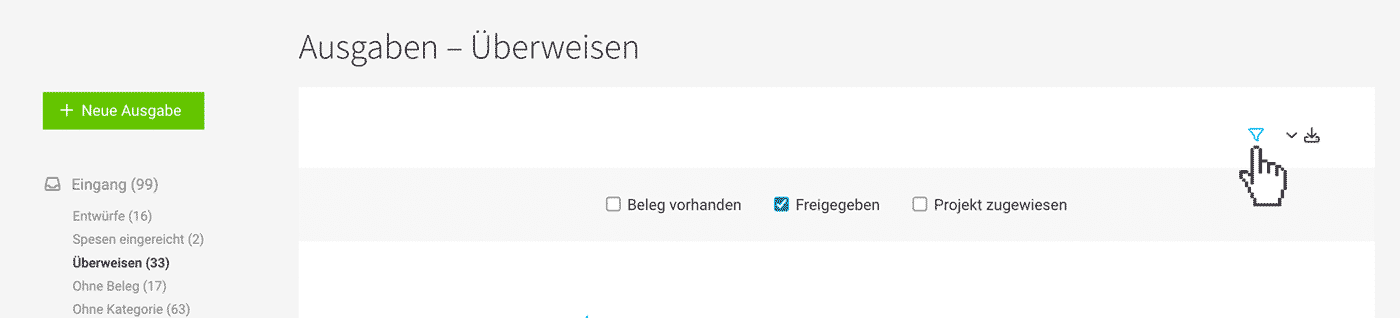 (English image not yet available)
(English image not yet available)Create a Bank Transfer Order
With MOCO, you can create SEPA bank transfer orders and execute them via online banking.
- The payment is scheduled in online banking for the day (or working day) before the due date.
- The payment reaches the supplier on time.
- Batch payments instead of individual payments can be selected.
- MOCO also automatically marks the purchase as Paid in MOCO (= records the payment on the scheduled date). If you use automatic payment reconciliation via a bank connection, the payment is then confirmed. These actions are logged via a comment in the purchase history, so they remain traceable for you.
To do in advance
Store your business account details in Settings under “Account” > “Currency & Account”, the IBAN for all suppliers, and, if personal expenses claims are to be reimbursed, also the IBAN for your staff.
Please note that from October 2025, a new requirement for recipient verification will apply in the EU for SEPA transfers. In addition to the IBAN, the bank will also check the recipient name/account holder. If these do not match exactly (e.g. missing legal form, incorrect organisation name), payments may be delayed. For this reason, the supplier form includes the “Account Holder” field. Fill in this field if the account holder differs from the company name you have entered.
Create a bank transfer order
1. Use the Smart Filter (1) to filter for all purchases to be paid by bank transfer. Personal expenses claims are also included. If invoice approval is used, you can use the “Approved” filter to show purchases that have already been approved.
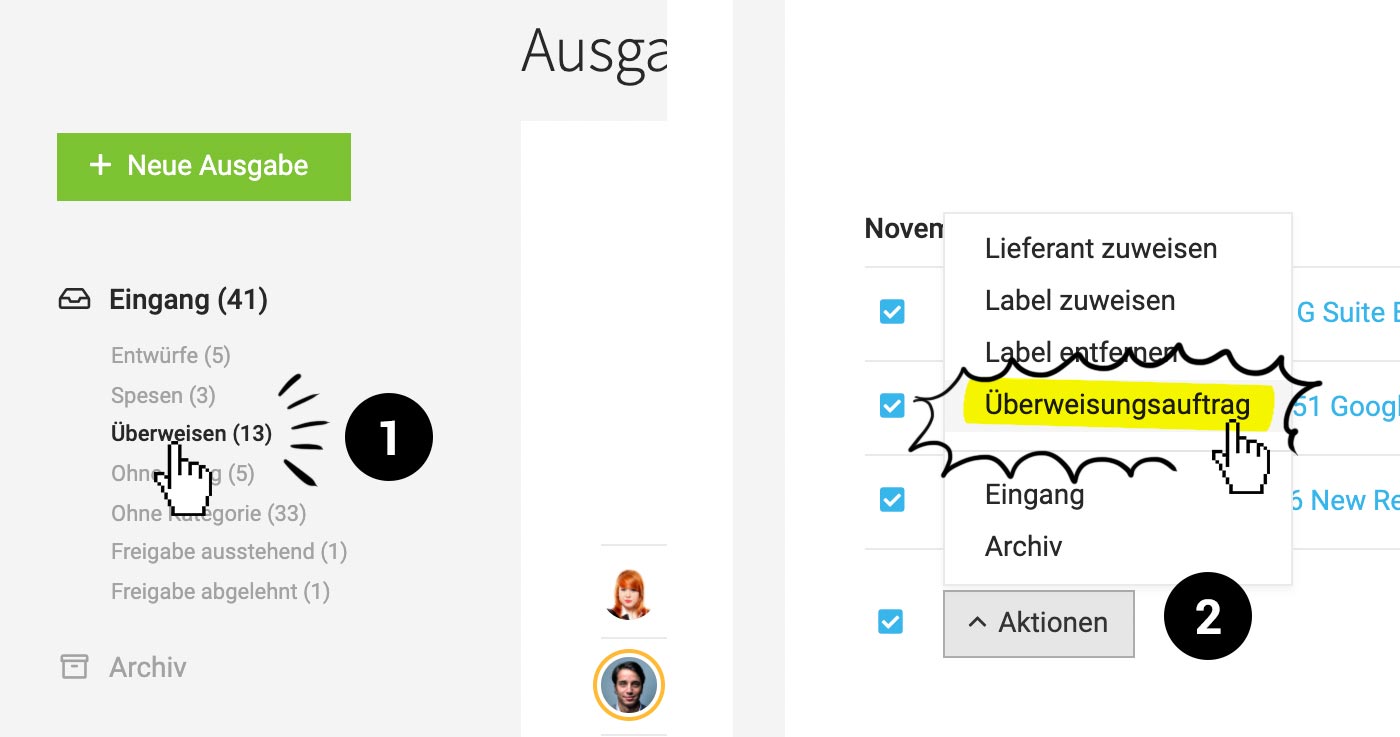 (English image not yet available)
2. Select the bulk action “Bank Transfer Order” (2) or, for a single purchase, select “Bank Transfer Order” from the dropdown on the right.
Store your business account details in Settings under “Account” > “Currency & Account”, the IBAN for all suppliers, and, if personal expenses claims are to be reimbursed, also the IBAN for your staff.
Please note that from October 2025, a new requirement for recipient verification will apply in the EU for SEPA transfers. In addition to the IBAN, the bank will also check the recipient name/account holder. If these do not match exactly (e.g. missing legal form, incorrect organisation name), payments may be delayed. For this reason, the supplier form includes the “Account Holder” field. Fill in this field if the account holder differs from the company name you have entered.
Create a bank transfer order
1. Use the Smart Filter (1) to filter for all purchases to be paid by bank transfer. Personal expenses claims are also included. If invoice approval is used, you can use the “Approved” filter to show purchases that have already been approved.
(English image not yet available)2. Select the bulk action “Bank Transfer Order” (2) or, for a single purchase, select “Bank Transfer Order” from the dropdown on the right.
3. MOCO checks whether all details required for a successful transfer are available.
4. After adding any missing details (the linked purchase opens in a new browser tab), refresh the view.
5. After confirming with “OK”, a bank transfer order (XML file) is created for all selected purchases.
6. Upload the XML file in online banking.
Access bank transfer orders later
All created bank transfer orders can be tracked under “Payments” together with the relevant invoices: list of all created bank transfer orders, included invoices (list & Excel export), and XML for downloading again.
4. After adding any missing details (the linked purchase opens in a new browser tab), refresh the view.
5. After confirming with “OK”, a bank transfer order (XML file) is created for all selected purchases.
6. Upload the XML file in online banking.
Access bank transfer orders later
All created bank transfer orders can be tracked under “Payments” together with the relevant invoices: list of all created bank transfer orders, included invoices (list & Excel export), and XML for downloading again.
Payment Reconciliation
a) via direct bank connection
You can also reconcile your outgoing payments directly via the bank connection. You can connect multiple banks (and one or more accounts). Payments for purchases are then recorded automatically (and the purchase is marked as paid).
- Connect a bank: In Settings, connect your bank(s) and select the accounts.
- Automatic payment reconciliation four times a day: After activation, MOCO uses finAPI to automatically check at regular intervals whether there are payments for recorded purchases. For recognition, the amount must match and there must be a clear assignment via reference, invoice number, or IBAN.
Currently, only open purchases are reconciled, or assignable payments are recorded in MOCO. At this stage, this ensures that salary payments or other sensitive purchase items do not unintentionally appear under “Payments” with full access to purchases. Ultimately, the development goal is to capture all outgoing payments in order to address missing receipts. - Inbox & Archive + not older than 3 months: MOCO recognises new outgoing payments from the time of activation. With each reconciliation, all purchases (in Inbox & Archive) without payments are checked. Once purchases or payments are older than 3 months, they are no longer considered.
- Confirmation of recorded bank transfer orders: Payments that have already been stored by MOCO via a bank transfer order are confirmed through payment reconciliation. MOCO records a corresponding comment on the purchase.
b) via CAMT file
Under “Payments”, you can upload the bank’s CAMT file (camt.053 and camt.054 file) at the top right for automatic payment reconciliation. Payments for purchases are then recorded automatically (and the purchase is marked as paid).
- Criteria for assignment: For identification, the invoice number and reference are key.
- Different amount
When reconciling payments via CAMT, MOCO actively flags if the gross invoice amount and the payment amount differ too much for a match. Assuming that a lower amount indicates a part payment, MOCO suggests “Partially paid” as the status in the reconciliation modal. As a user, you can confirm or remove this.
Unassigned payments can be assigned manually.
Record a Payment Manually
Payments can also be recorded manually. To do this, click the status icon under “Purchases” or in “Suppliers” (1) or record the payment directly on the purchase via the button at the top right (2).
Show all purchases where no payment has been recorded yet
Under “Payments”, use the “+” to see all open documents available for payment entry, and you can search directly for an invoice. (3)
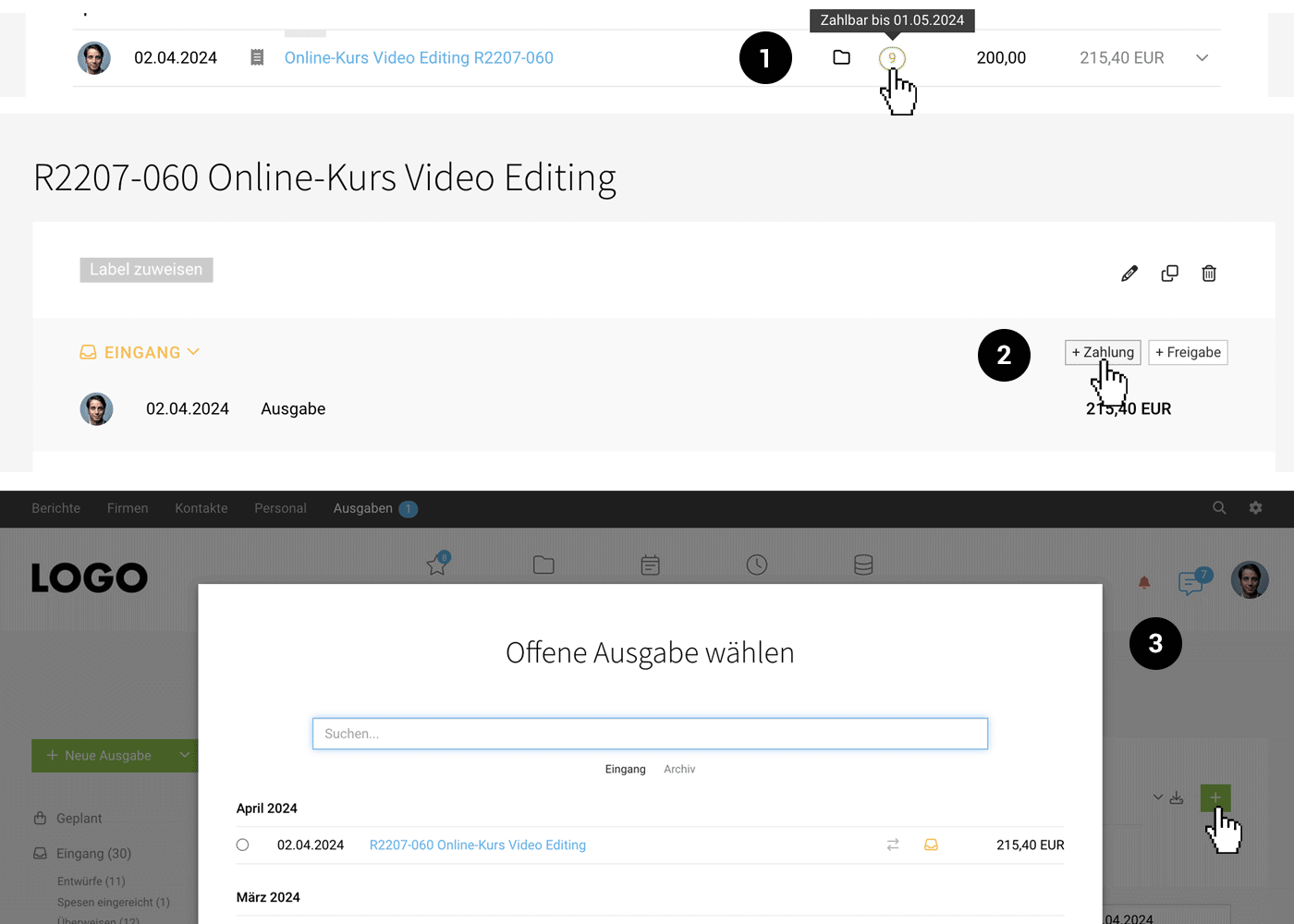 (English image not yet available)
Record a batch payment
See below: “Mark all or multiple invoices as paid”
Record payments with one click
See below: “Mark all or multiple invoices as paid”
 (English image not yet available)
Credit Card
Credit Card Integration
Full integration that offers synchronisation of credit card payments and receipts.
Synchronise credit card payments, including receipts, with MOCO
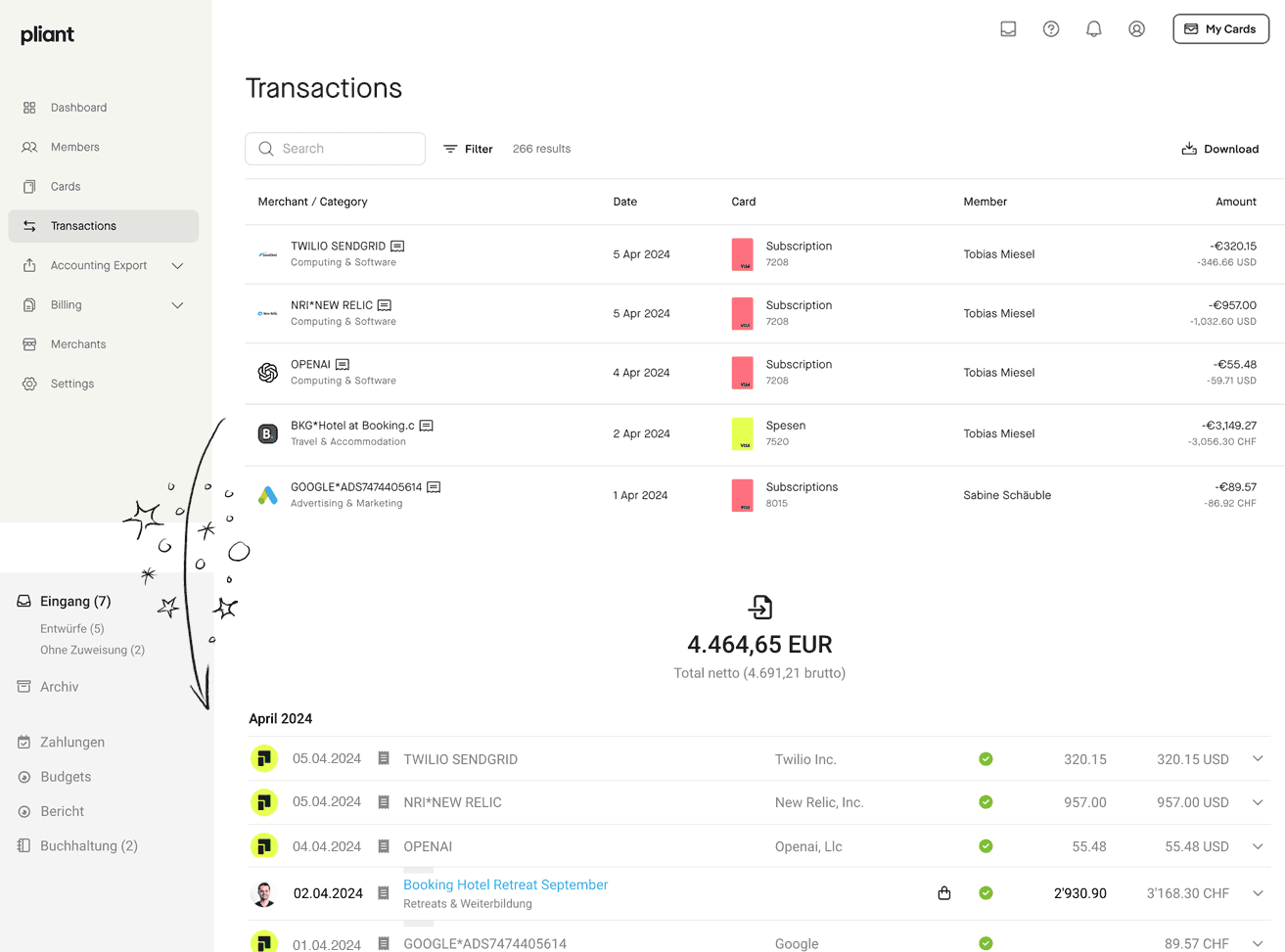 (English image not yet available)
Synchronise credit card payments, including receipts, with MOCO
(English image not yet available)Manually reconcile the credit card statement
The credit card provider debits the monthly total from the business account. This is the effective payment date for your cashflow.
1. Go to “Payments” (see image above – 3)
2. Select the payment method “Credit Card” and the month that includes the debit from the account.
3. Now record the payments individually via the “+” at the top right (use the debit date of the credit card statement from the business account as the date) and tick them off on the credit card receipt.
4. At the end, the total in the filtered view should match the credit card statement exactly.
4. At the end, the total in the filtered view should match the credit card statement exactly.
Other
Mark all or multiple invoices as “Paid”
This option is helpful if, for example, you manage all payments in DATEV and want to quickly mark invoices as paid in bulk: select all or specific purchases, then choose the “Record Payment” action at the bottom left.
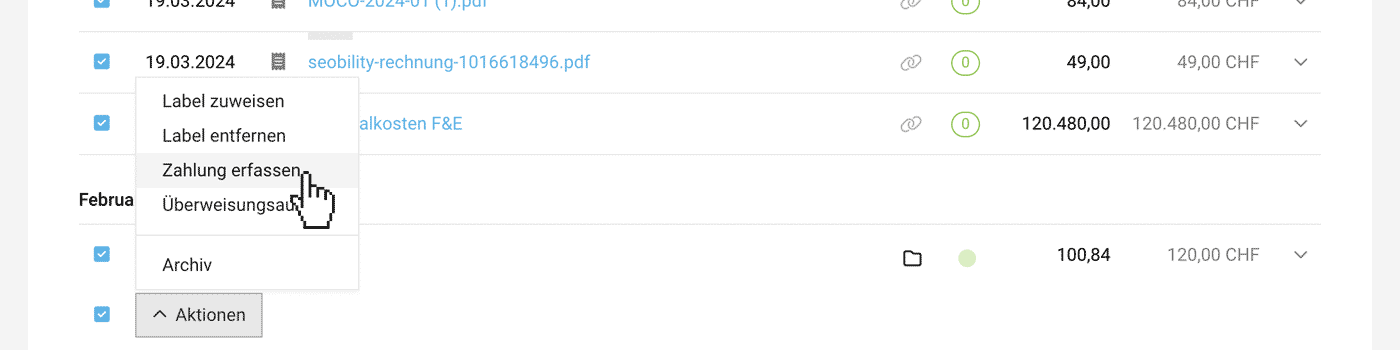 (English image not yet available)
(English image not yet available)Record other payments
In principle, under “Payments” you can also record a payment without a document. This then affects the total outgoing payments and the cashflow report.
You can assign a purchase to payments without a document later (dropdown on the right: “Assign”)
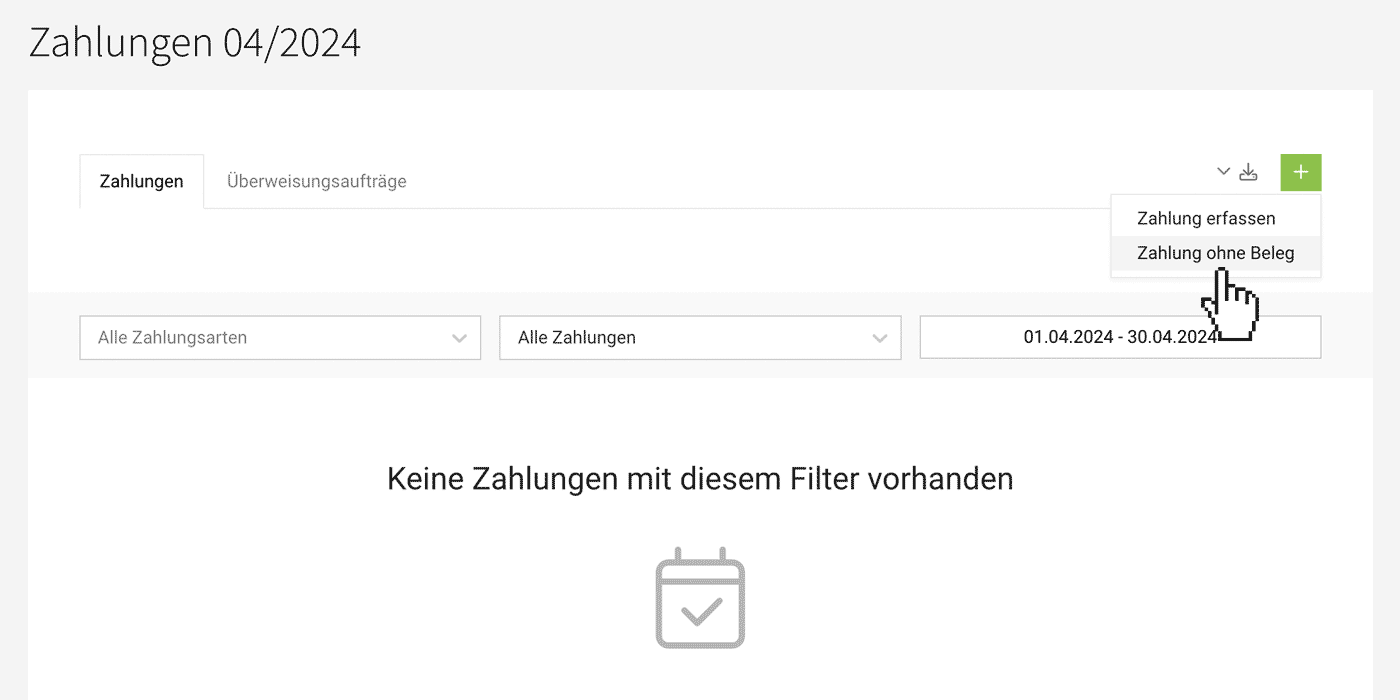 (English image not yet available)
You can assign a purchase to payments without a document later (dropdown on the right: “Assign”)
(English image not yet available)Part payment / early payment discount
If a part payment is recorded, MOCO automatically suggests the status “Partially paid”. All partially paid purchases can be opened with one click via the Smart Filter “Partially paid”.
- If you include the purchases in the bank transfer order, the difference is taken into account.
- For purchases where the payment differs due to an early payment discount, the status “Paid” is the right choice. The differences are handled accordingly in accounting.
Labels
As is well-known from other areas, you can create labels for incoming invoices to categorise them individually or mark them temporarily.
To manage or assign labels, click on the small grey bar in the row.
Multiple incoming invoices can be marked at once by selecting them (see image).
 (English image not yet available)
To manage or assign labels, click on the small grey bar in the row.
Multiple incoming invoices can be marked at once by selecting them (see image).
(English image not yet available)