Types of Invoicing
Time & Materials | From Proposal / Flat Rate | Custom Invoice | Mixed Forms | Interim & Final Invoice | Consolidated Invoice | Invoice Without Project | Automated/Bulk Invoicing for SubscriptionsTime & Materials
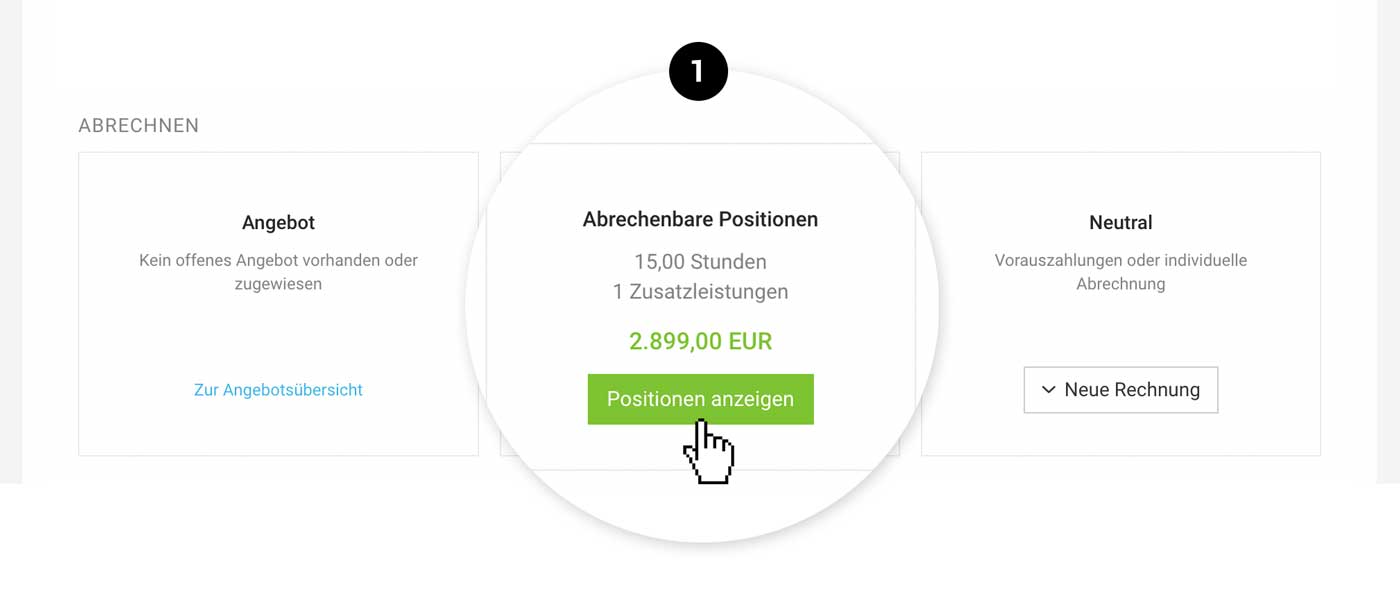
If the Billing type Time & Materials is selected in the project, billable hours and additional services are collected as potentially billable line items in the Project List and in the project or client under “Billing”. Click “Show Line Items” (1) to create the invoice directly.
 (English image not yet available)
(English image not yet available)Adjustments Before Billing
Time entries can be edited and adjusted for Billing. This lets you fix spelling mistakes in the activity description or round hours up or down.
Adjust hours for Billing
Adjust hours for Billing
Filter Options
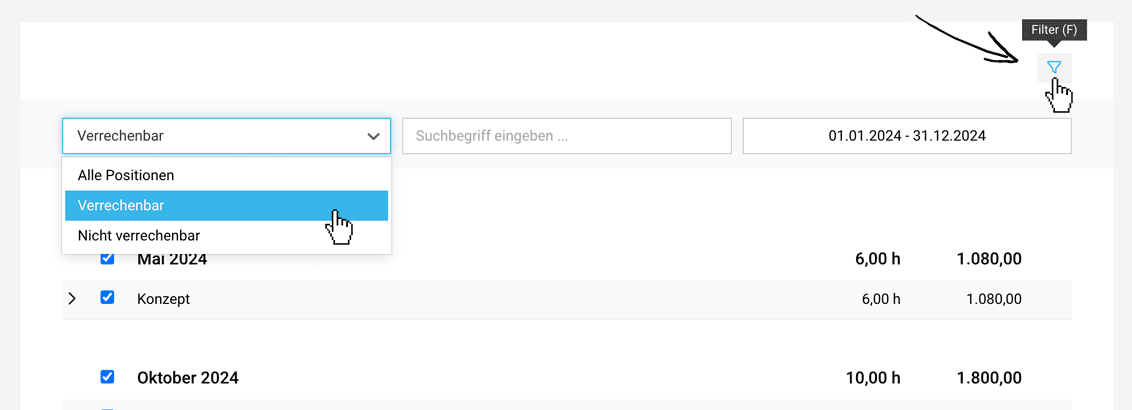
When Billing within a project, you can use the Filter (keyboard shortcut “F”)
- to review non-billable line items and include them on the invoice. For example, you can show goodwill items for the client on the invoice or the Timesheet.
- to filter by topics/tasks
- to filter by time period
 (English image not yet available)
Invoice Layout
You decide how detailed or compact the line items appear on the invoice.
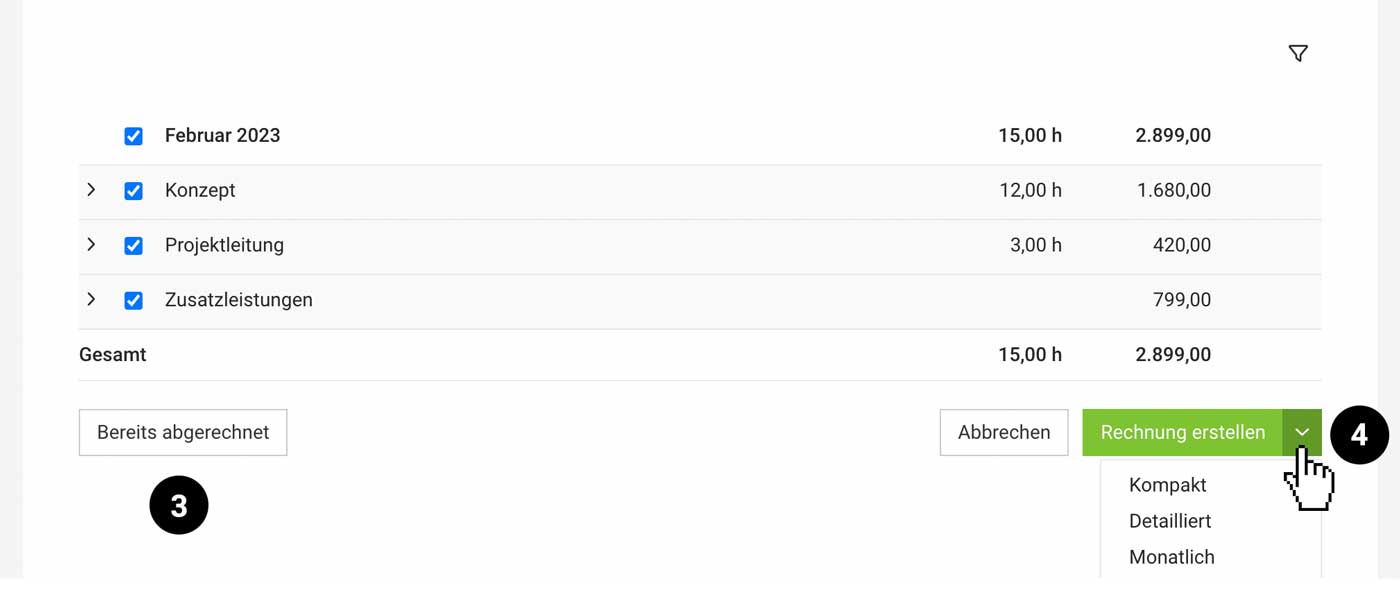
- Monthly: Line items are grouped by month.
- Detailed: Line items are shown with the activity description. You can bill selected hours from time tracking, including the description, as line items.
- Compact:Line items are not grouped by month, and services are summarised.
The default can be set globally and can also be changed per invoice (2) (alternative options can be selected via the button dropdown).
 (English image not yet available)
(English image not yet available)Billing services with an hourly rate per person
If “Hourly rate per person” is selected in the project, Billing is done per person by default. You can change this to “by service” in the settings. More about this setting
Billing in days
Instead of Billing by the hour (the default), you can switch to Billing in days. More about this setting
Automatically Attach the Related Timesheet
The Timesheet is created automatically for the invoice and can be integrated directly into the PDF (checkbox at the end of the invoice form). If you select this option in advance for the client or project, the checkbox is preselected automatically.
Mark Line Items as Already Invoiced
If billable line items have already been invoiced elsewhere, use “Show Line Items” to mark the selected line items as “Already invoiced” (see above – 3). This creates an entry in the invoice list for the client and project (traceable/approval possible).
When you archive the project, any remaining open line items are automatically marked by MOCO as already invoiced.
When you archive the project, any remaining open line items are automatically marked by MOCO as already invoiced.
Releasing Invoiced Hours Again
Hours that have been included in an invoice are locked. You can release them again by
a) cancelling or deleting the invoice
b) editing the invoice and deleting individual line items (if the invoice has not yet been sent).
a) cancelling or deleting the invoice
b) editing the invoice and deleting individual line items (if the invoice has not yet been sent).
Add Effort to the Invoice Later
Traceability: Which Invoice Line Items Were Billed On
In the Timesheet and under additional services, MOCO shows (on hover over the “i”) in a tooltip which invoice the line item was billed on, or whether and when the line item was marked as already invoiced. This information is also available via the API
Billing Forecast
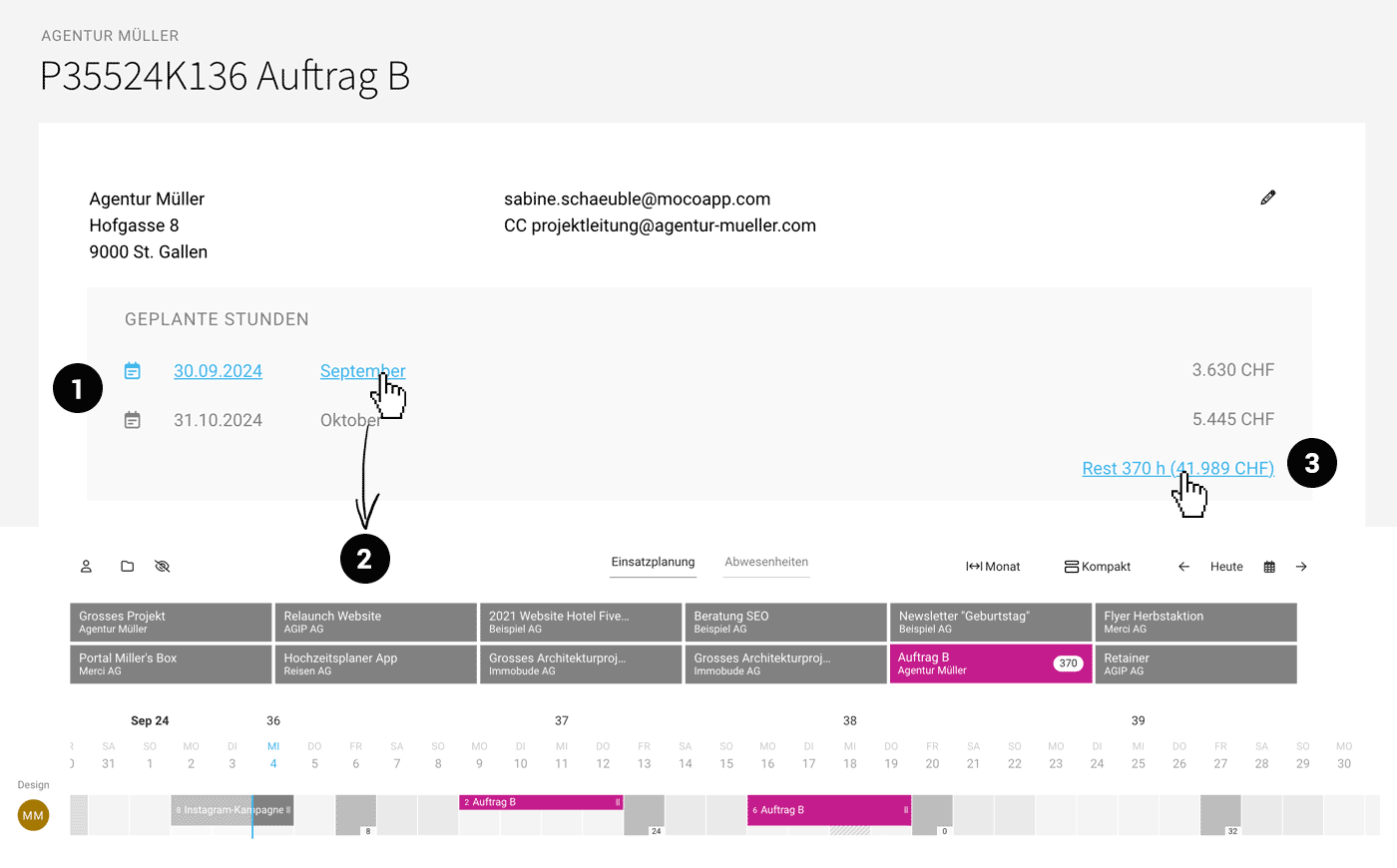
On the Billing page, planned hours (capacity planning) are shown as a total billable amount up to the end of the month (1).
The corresponding item in the Financial Report links directly to this project, and this view links on to planning (2). You can then adjust it there if needed.
More information on hour budgets (Time & Materials Billing with a monthly budget)
 (English image not yet available)
The corresponding item in the Financial Report links directly to this project, and this view links on to planning (2). You can then adjust it there if needed.
More information on hour budgets (Time & Materials Billing with a monthly budget)
(English image not yet available)From Proposal / Flat Rate
For a proposal to be invoiced, it must be assigned to a client.
Project-Based
When the proposal is invoiced, it usually involves a fixed-price/flat-rate project. The invoicing plan to be completed (1) controls the invoicing note and revenue forecast.
Project-Based
When the proposal is invoiced, it usually involves a fixed-price/flat-rate project. The invoicing plan to be completed (1) controls the invoicing note and revenue forecast.
Direct invoicing within the project:
Select the proposal if not already selected (2) and choose "Invoice Proposal." Through the modal, the entire proposal or specific items can be invoiced. Then mark the invoicing plan as completed.
Select the proposal if not already selected (2) and choose "Invoice Proposal." Through the modal, the entire proposal or specific items can be invoiced. Then mark the invoicing plan as completed.
.png "Umsatzforecast Abrechnungsplan: Angebot abrechnen Teilrechnung") (English image not yet available)
(English image not yet available)Invoicing can also be done in the proposal detail view at the top right or in all lists on the right via the dropdown:
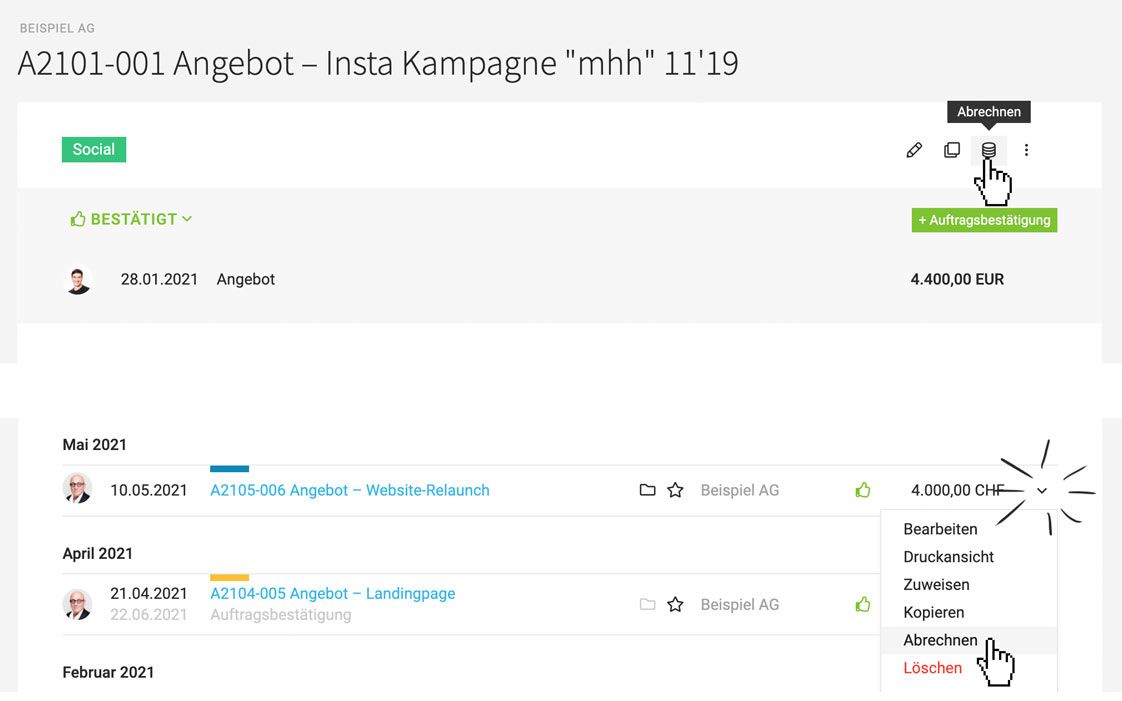 (English image not yet available)
Without Project
If a proposal is not assigned to a project, the created invoice is automatically assigned to the client. In the client under "Invoicing", invoicing can be done similarly to the project level, and client-specific invoices are listed. An invoice can also be subsequently assigned to a project.
Partial Invoice
Only certain items can be invoiced (2 + 4) – MOCO then shows the remaining amount or offers the open items for the next invoice. You can also use the small blue link to view all items of the proposal again.
Add Expenditures
Optionally, selected additional expenditures can be added.
Advance & Final Invoice
If an amount is to be invoiced as a percentage, it is usually not a partial invoice but an advance invoice. Certain rules must be followed here » Advance invoices and their automatic deduction in the final invoice.
Batch Invoice at Client Level
Items recorded in the invoicing plan are also offered under "Billable Items." This can be useful for a batch invoicing at the client level from flat rates.
Already Invoiced
If the proposal has already been invoiced elsewhere, it can be set to "Already Invoiced" by selecting "Select Open Proposal" (2) (Status Invoiced is assigned).
Custom Invoice
In the Client or Project under "Invoicing" via "Neutral" (1) you can also create a completely custom, individual invoice.
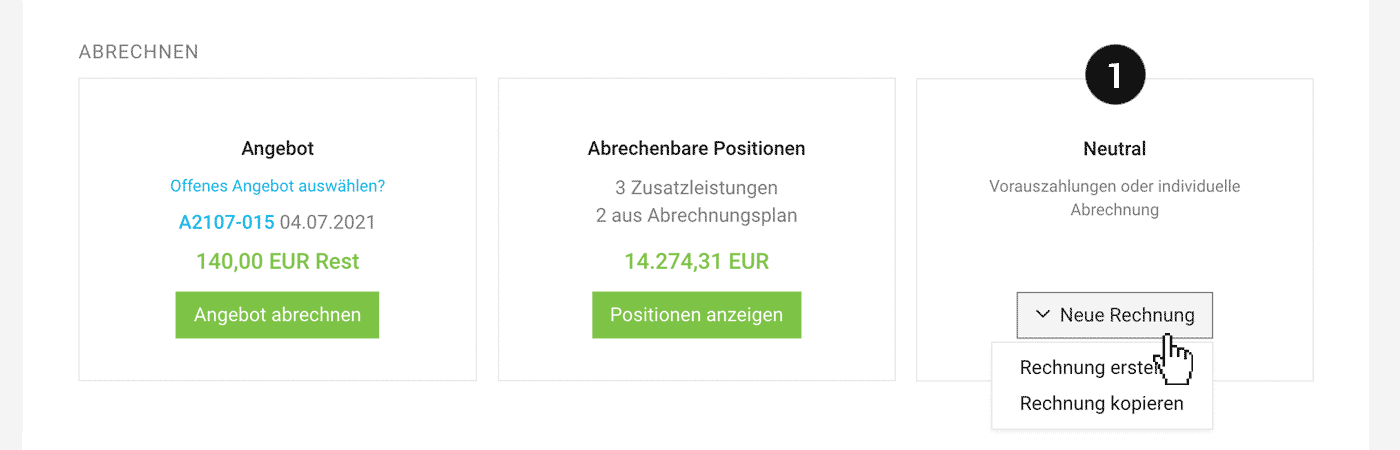 (English image not yet available)
(English image not yet available)- Pre-record sections/items: If needed, items from the service catalogue or recorded billable items can be manually inserted.
- Copy invoice: Any previous invoice can be selected as a template.
Neutralize positions covered by this
Any covered billable items can be marked as "invoiced" via "Show items" so they no longer appear as open. MOCO automatically marks them when you archive a project.
Mixed Forms
Add Billable Items to an Invoice Afterwards
You can now add individual or all billable items to an invoiced proposal or a customised invoice. To do this, select "New Item" > "Billable Items" via the green button in the invoice.
(only within a project)
(only within a project)
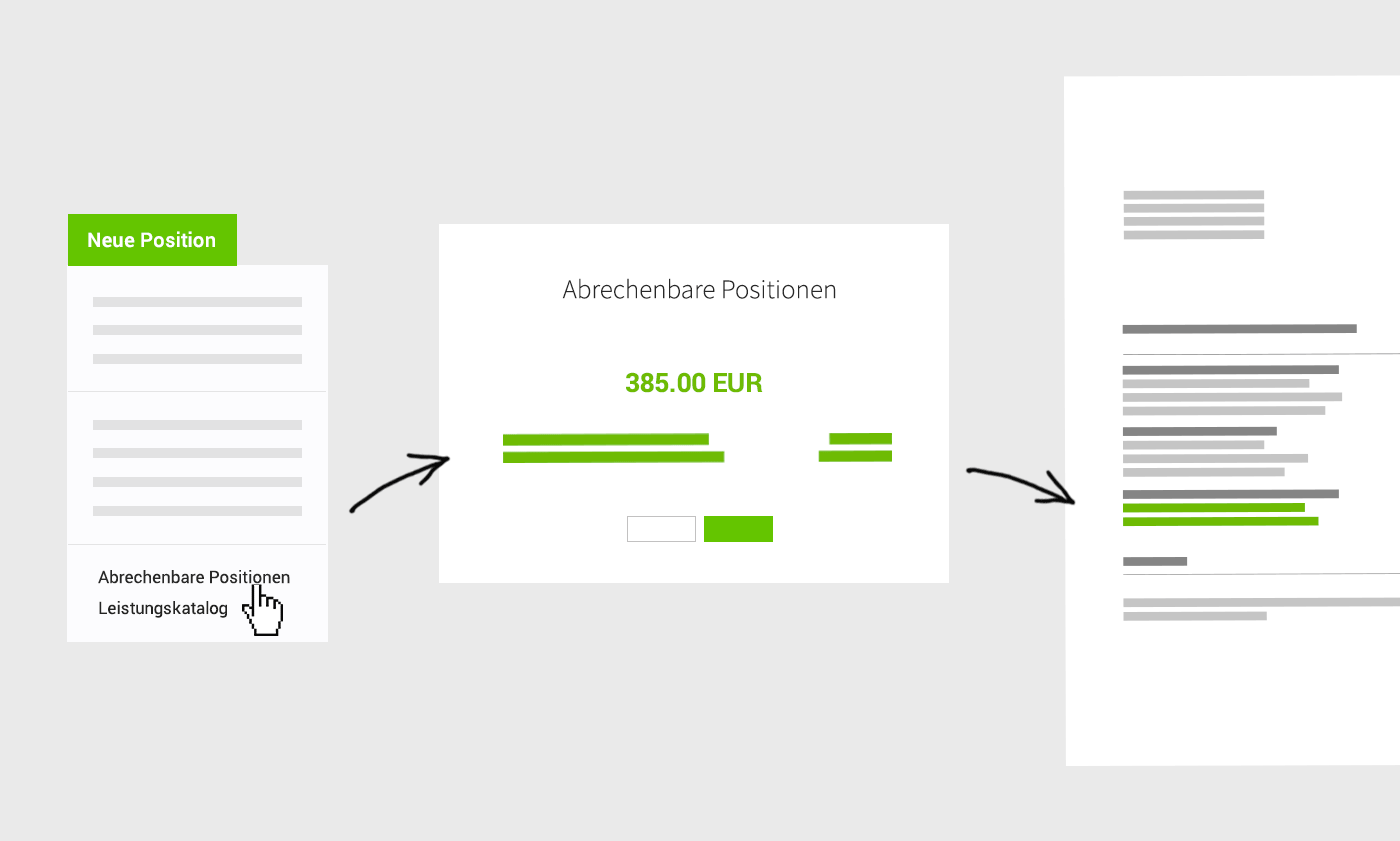 (English image not yet available)
Interim & Final Invoice
Interim payments (deposit invoices, advance payment invoices) are prepayments, regardless of any work already delivered. For interim and final invoices, certain content requirements are relevant. MOCO supports you with the automated process shown below to help you meet these requirements – and automatically deducts interim invoices. This always works within a project. If interim and final invoices are needed at client level, the steps must be done manually.
 (English image not yet available)
Create an Interim/Deposit Invoice
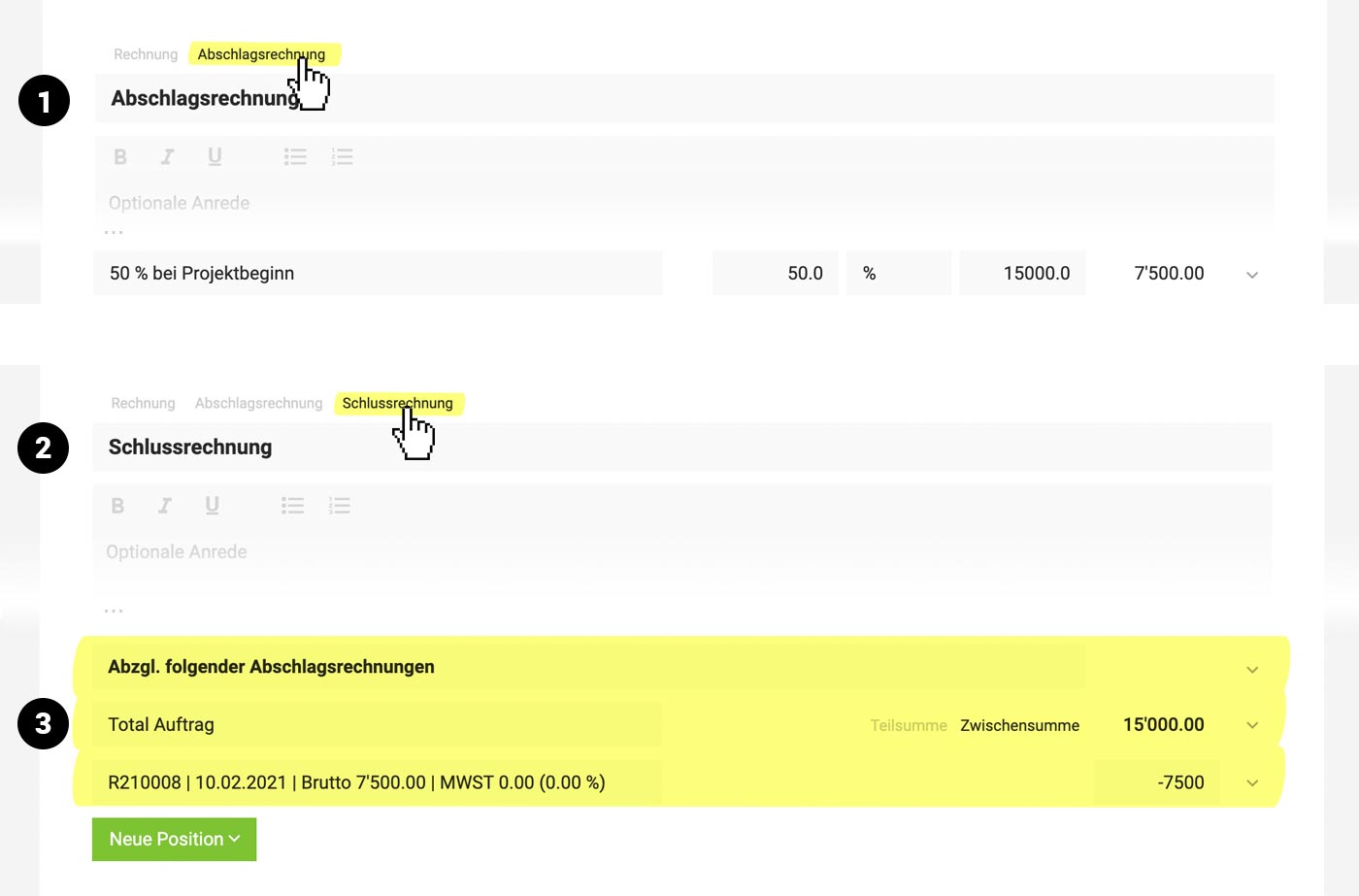
1. As an interim invoice is a prepayment independent of work delivered, a single line item with a percentage amount (or a fixed amount, depending on what you have agreed) is usually the best option. To do this, use the entry you created in advance in the Billing plan, or in the project under "Billing" in the right-hand "Neutral" box, and add a percentage line item.
2. In the invoice form, above the title, select "Interim Invoice" (1). The term "Interim Invoice" is then automatically suggested in the title (the term Interim Invoice – or a comparable term – should appear in the title). If you have multiple interim invoices, numbering is recommended ("Interim Invoice 1", "Interim Invoice 2", etc.).
Interim invoices are always without discount, as they are an independent deposit amount. Any discount is only applied on the final invoice.
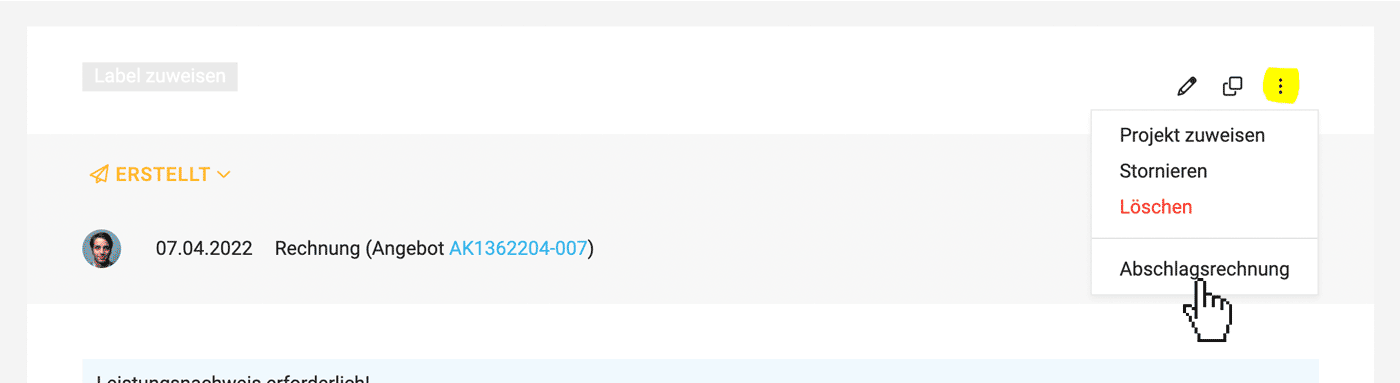
If you forgot to mark it as an interim invoice, you can do this later at the top right of the invoice (you may need to adjust the title manually):
 (English image not yet available)
2. In the invoice form, above the title, select "Interim Invoice" (1). The term "Interim Invoice" is then automatically suggested in the title (the term Interim Invoice – or a comparable term – should appear in the title). If you have multiple interim invoices, numbering is recommended ("Interim Invoice 1", "Interim Invoice 2", etc.).
Interim invoices are always without discount, as they are an independent deposit amount. Any discount is only applied on the final invoice.
If you forgot to mark it as an interim invoice, you can do this later at the top right of the invoice (you may need to adjust the title manually):
(English image not yet available)Tip for time-and-materials projects: Work against the interim amount
If you have created an interim invoice in a time-and-materials project, newly recorded items are still treated as "billable items" regardless. Here is one way to handle this for revenue forecasting:
a) Create a negative additional service (billable, not in budget, costs 0): a negative amount will be shown under "billable items" until the interim amount has been used up.
b) Each month, mark the services covered by the interim invoice as "already invoiced".
If you have created an interim invoice in a time-and-materials project, newly recorded items are still treated as "billable items" regardless. Here is one way to handle this for revenue forecasting:
a) Create a negative additional service (billable, not in budget, costs 0): a negative amount will be shown under "billable items" until the interim amount has been used up.
b) Each month, mark the services covered by the interim invoice as "already invoiced".
Create a Final Invoice
Existing interim invoices are deducted automatically
1. Invoice the Quote and, above the title, select "Final Invoice" (2).
2. The term "Final Invoice" is then automatically suggested in the title (a final invoice should be titled accordingly. The title "Final Invoice" implies that there have been interim payments).
3. In a separate section after a subtotal "Total order" (which indicates the total net amount of the Quote), MOCO automatically deducts the interim invoices net, including the relevant details (3) (invoice number, invoice date, gross amount, VAT amount, and VAT rate).
1. Invoice the Quote and, above the title, select "Final Invoice" (2).
2. The term "Final Invoice" is then automatically suggested in the title (a final invoice should be titled accordingly. The title "Final Invoice" implies that there have been interim payments).
3. In a separate section after a subtotal "Total order" (which indicates the total net amount of the Quote), MOCO automatically deducts the interim invoices net, including the relevant details (3) (invoice number, invoice date, gross amount, VAT amount, and VAT rate).
Special case: temporary VAT reduction in Germany
If an interim invoice was issued with a different tax rate from the final invoice, this difference must be corrected. MOCO calculates the tax correction and shows it on the final invoice.
Multiple final invoices within one project?
In principle, there is one final invoice per project. However, there are cases where you may want to create multiple final invoices, for example if a project is billed to several recipients. In this case, when creating the first final invoice, delete the interim invoices you do not need – they will be suggested for deduction again automatically when you create a new final invoice.
If an interim invoice was issued with a different tax rate from the final invoice, this difference must be corrected. MOCO calculates the tax correction and shows it on the final invoice.
Multiple final invoices within one project?
In principle, there is one final invoice per project. However, there are cases where you may want to create multiple final invoices, for example if a project is billed to several recipients. In this case, when creating the first final invoice, delete the interim invoices you do not need – they will be suggested for deduction again automatically when you create a new final invoice.
Part Invoice versus Interim and Final Invoice
Part invoices are invoices for work already delivered. The scope of work is specified on the invoice. Part invoices are self-contained and do not require a final invoice. Sometimes, however, you may still want to label the last invoice as "Final Invoice" to make it clear that it is the last part invoice for a project. Create a part invoice from a Quote.
Links
More detailed information on interim invoice versus part invoice
What do I need to consider for an interim and final invoice?
Links
More detailed information on interim invoice versus part invoice
What do I need to consider for an interim and final invoice?
Consolidated Invoice
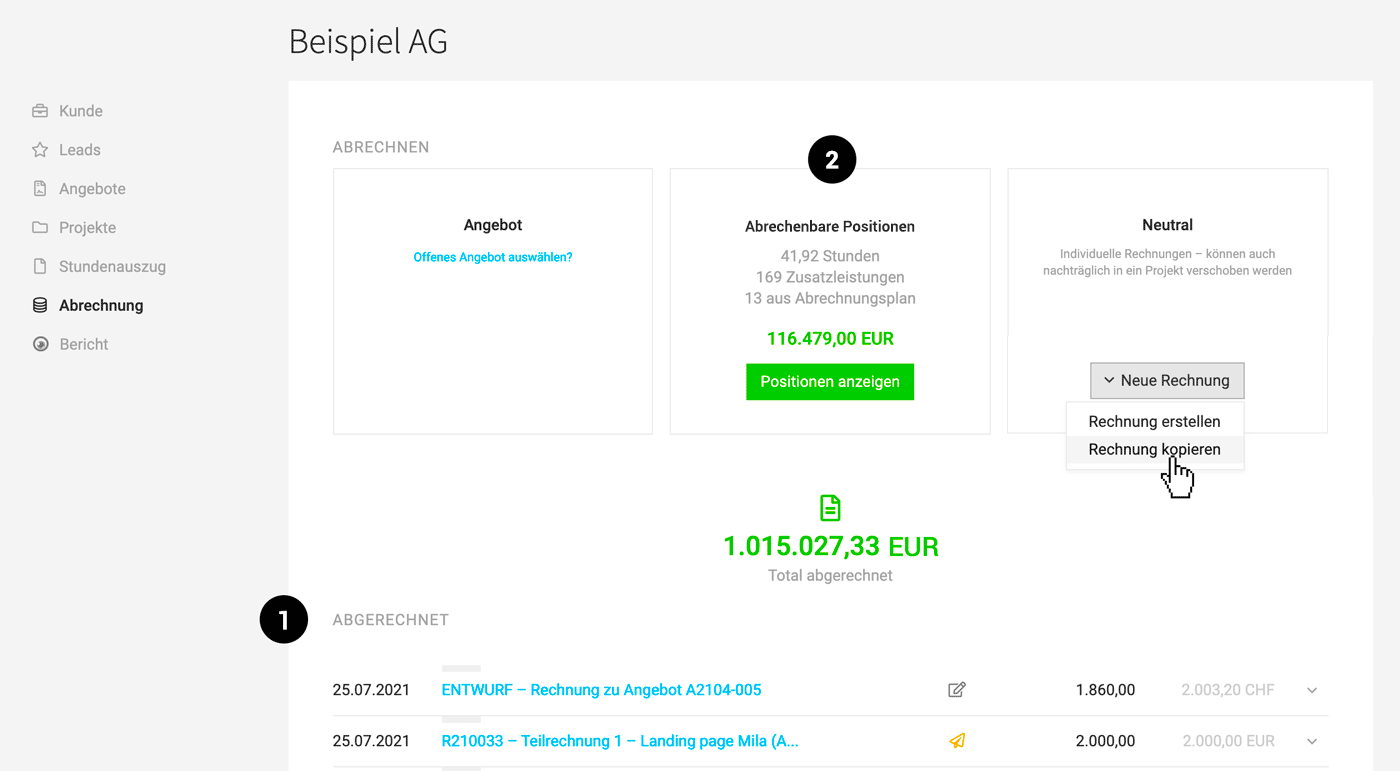
Under "Invoicing" in the client section, all client-related invoices are listed (1).
Cross-Project Consolidated Invoice
Under "Billable Items" (2), cross-project consolidated invoices can be created.
In the relevant projects, the consolidated invoice is listed under "Invoicing" with the note "Consolidated Invoice" – and is accounted for as revenue.
 (English image not yet available)
Project Group Consolidated Invoice
Clicking on the billable amount for the project group generates the Project Group Invoicing (automatically filtered consolidated invoice).
Cross-Project Consolidated Invoice
Under "Billable Items" (2), cross-project consolidated invoices can be created.
In the relevant projects, the consolidated invoice is listed under "Invoicing" with the note "Consolidated Invoice" – and is accounted for as revenue.
(English image not yet available)Project Group Consolidated Invoice
Clicking on the billable amount for the project group generates the Project Group Invoicing (automatically filtered consolidated invoice).
Invoice Without Project
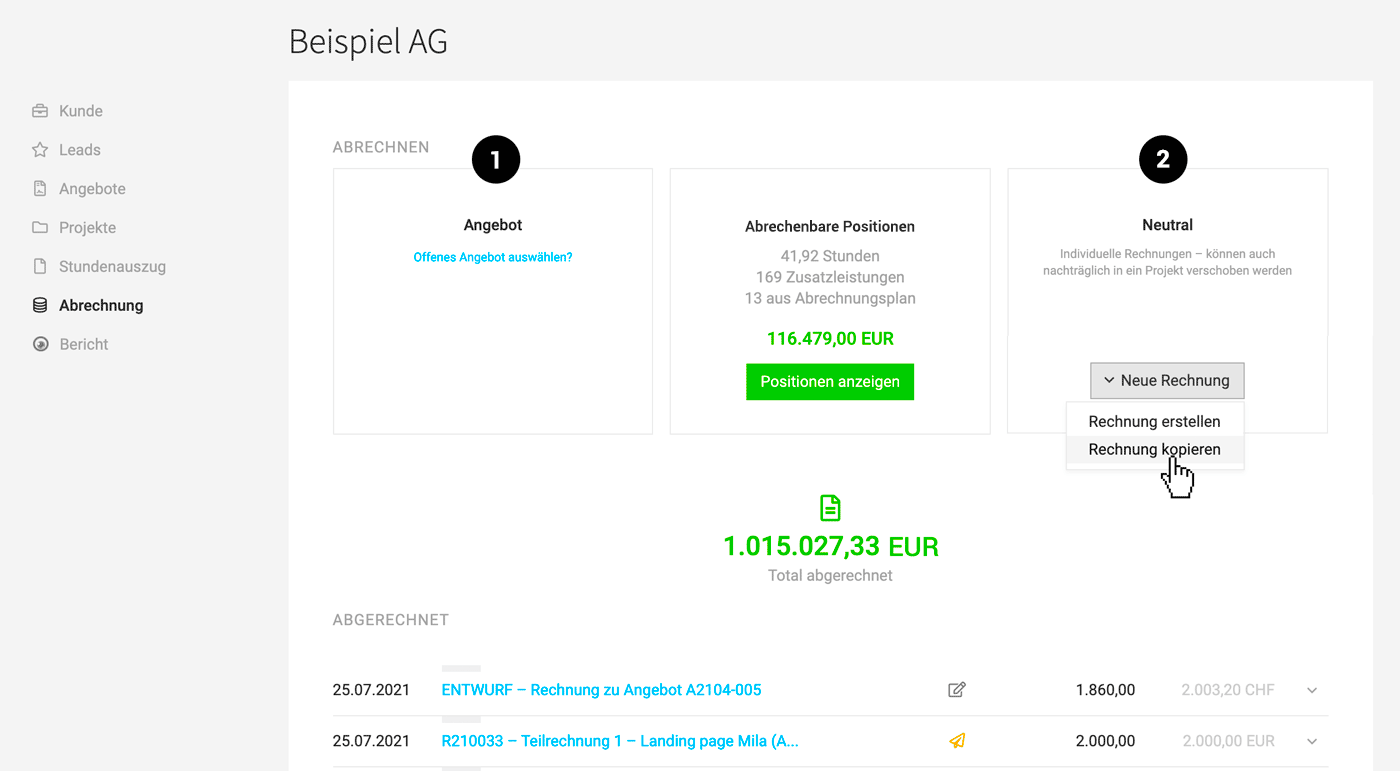
Invoices can be created even without projects. What is always required is a Client. You then create the Invoice directly from the Proposal or under the Client:
 (English image not yet available)
Invoicing Proposals (2)
All open Proposals assigned to the Client are offered for selection and can be invoiced in full or partially. Proposals can also be invoiced in the lists or directly on the detail view.
Individual Invoice
A free Invoice is created via "Neutral" (4). Any existing Invoice can also be searched and copied.
Free Invoices can be assigned to projects retrospectively if needed.
(English image not yet available)Invoicing Proposals (2)
All open Proposals assigned to the Client are offered for selection and can be invoiced in full or partially. Proposals can also be invoiced in the lists or directly on the detail view.
Individual Invoice
A free Invoice is created via "Neutral" (4). Any existing Invoice can also be searched and copied.
Free Invoices can be assigned to projects retrospectively if needed.
Automated/Bulk Invoicing for Subscriptions
Certain invoices can be generated and sent through a batch action. This means triggers here are billable items – for example, the automatic invoicing schedule for retainers or billable services recorded in a project.
Invoices you can create with a single click
For example, domains, hosting, etc.
For subscriptions and hosting, etc., a dedicated project (based on effort without a budget) is created for the client, and under "Additional services," a so-called recurring additional service is recorded (billable & not within the budget). This acts as a trigger with a reference date and duration. On the reference date, the additional service is created and can be invoiced (optional: notification about this).
Retainer
When you set up a retainer in MOCO, it creates an automatic invoicing schedule, and the monthly amount can be invoiced on the chosen reference date (selectable in the invoicing schedule including text). All about the retainer
For subscriptions and hosting, etc., a dedicated project (based on effort without a budget) is created for the client, and under "Additional services," a so-called recurring additional service is recorded (billable & not within the budget). This acts as a trigger with a reference date and duration. On the reference date, the additional service is created and can be invoiced (optional: notification about this).
Retainer
When you set up a retainer in MOCO, it creates an automatic invoicing schedule, and the monthly amount can be invoiced on the chosen reference date (selectable in the invoicing schedule including text). All about the retainer
Monthly or periodic invoicing of efforts
All recorded billable hours and additional services are in projects with the invoicing type "based on effort." All about effort-based projects
NOT intended is the option when individual proposals need to be invoiced or individual invoices created. Here, you click as usual on the billable amount in the project list and create the invoice in the project under "Invoicing" (or in the client under "Invoicing").
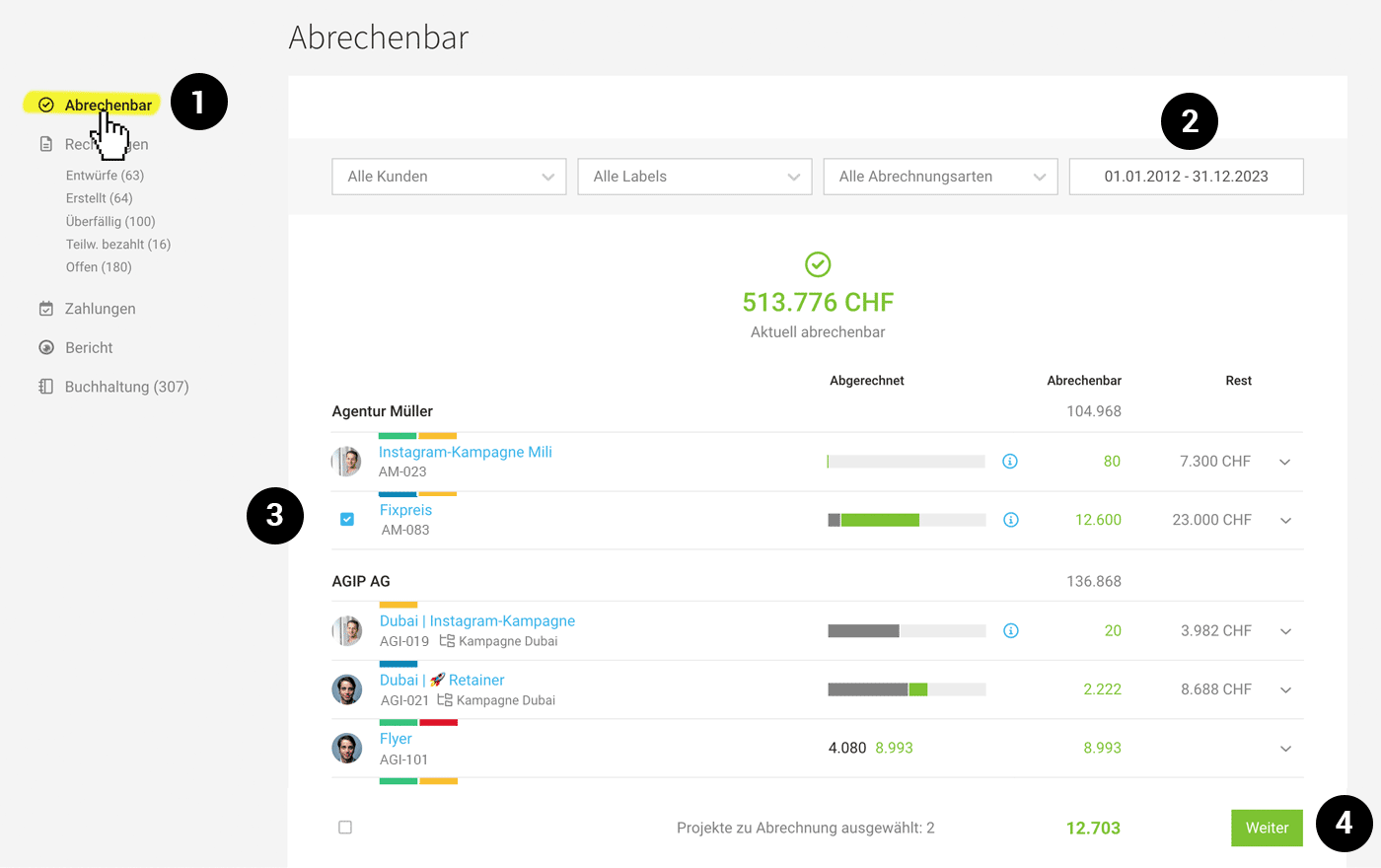
Go to "Invoicing" > "Billable"
1. Filter by period, label, etc.
2. Select all or specific projects and click "Next" (3)
4. Create invoices
Alternatively, you can first create drafts. These can be easily deleted, making them particularly suitable for initial tests.
 (English image not yet available)
The blue "i" displays any invoicing info that may be stored.
Bulk Dispatch
Under "Invoicing" > "Invoices," select the Smart Filter "Created" on the left, choose invoices for dispatch, and initiate the dispatch via "Next" at the bottom right.
2. Select all or specific projects and click "Next" (3)
4. Create invoices
Alternatively, you can first create drafts. These can be easily deleted, making them particularly suitable for initial tests.
(English image not yet available)The blue "i" displays any invoicing info that may be stored.
Bulk Dispatch
Under "Invoicing" > "Invoices," select the Smart Filter "Created" on the left, choose invoices for dispatch, and initiate the dispatch via "Next" at the bottom right.
Checklist for good preparation:
- Use labels e.g., "Invoicing monthly," "Invoicing annually," ...
→ This way, projects to be invoiced can be filtered with one click (1) - Standardize the reference dates of recurring services across clients
→ e.g., always record the recurring service with a reference date of the 27th of a month and invoice at the end of the month or on the 1st of the following month. - Check data used by MOCO for automatic invoicing
→ Since MOCO composes the invoice title as: "Invoice – Project Name", the project name should be descriptive.
→ Check client-specific details like payment terms or closing text
→ Record project-specific details like invoice contact, timesheet, invoicing note
Define standards for client and project
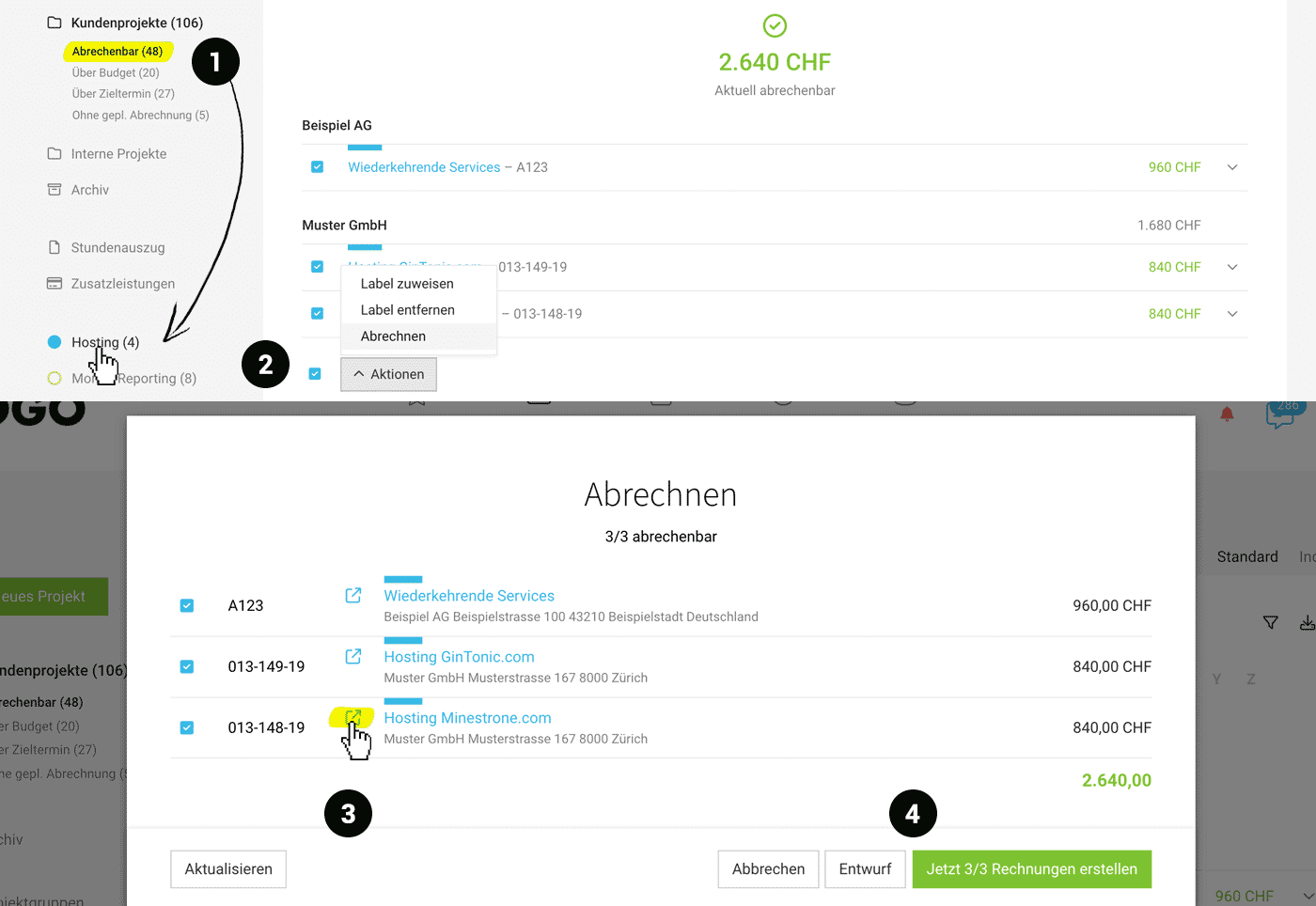
Alternative Option: Use the Smart Filter "Billable" under "Client Projects" for bulk creation
The example shows the additional restriction to a label under "Billable." This way, the bulk action can be specifically applied to a particular project segment.
 (English image not yet available)
1. Auf Smart Filter "Abrechenbar" gehen, dann nach Label filtern, 2. Massenaktion "Abrechnen" wählen 4. Kontrollieren, korrigieren, aktualisieren und 4. Entwürfe oder Rechnungen direkt (mit Vergabe der Rechnungsnummer) erstellen.