Article from
Invoice Numbering, Number Ranges – Info & Examples.
Legally, there are only a few requirements regarding the numbering of invoices: The invoice number must follow a system, be unique, and sequential. A persistent myth is that it must be gapless. We provide a practical overview.
 (English image not yet available)
Legal Regulations
Switzerland
In Switzerland, invoices do not even need a number from a tax perspective. See the article on the SME portal of the Swiss Confederation.
Germany (and EU)
A continuous invoice numbering is mandatory.
Why are invoice numbers needed?
In Switzerland, invoices do not even need a number from a tax perspective. See the article on the SME portal of the Swiss Confederation.
Germany (and EU)
A continuous invoice numbering is mandatory.
Why are invoice numbers needed?
Invoice numbers allow, among other things, the tax authorities to keep track of the number of invoices issued in a calendar year. During an audit, they serve as a clear assignment and reconciliation with the bookkeeping of business partners.
If invoice numbers are missing on supplier invoices or invoices to clients, the worst-case scenario is that the invoice may not be recognized by the tax authorities, or there may be additional tax payments. A client is not obliged to pay an invoice without an invoice number.
The minimum requirement for an invoice number
- It must be unique
- It must be sequential
- It can contain numbers and letters and also multiple number sequences
System / Number Range
The requirement for the invoice number to follow a system is already met by the sequential numbering. This is also referred to as a number range.
The requirement for the invoice number to follow a system is already met by the sequential numbering. This is also referred to as a number range.
In MOCO, the number range for automatic number assignment is defined in the settings under "Number Ranges" > "Invoices". MOCO ensures that no number can be assigned twice.
Examples of Number Ranges
Choosing the Invoice Number Range
Everyone has different preferences. The goal is clear data. Too much creativity can lead to chaos. We show three examples of good numbering and explain the systematics of each.
0123
The Simplest – a simple, incrementing number
A purely sequential number without resetting is the simplest and most unambiguous solution.
MOCO Checklist
- {C} = Enter variable for the incrementing automatic number.
- Choose minimum width. The example is based on a minimum width of 4 digits.
- Optional addition: Letters for context assignment (e.g., "R" for invoices or "D" for services).
- Choose starting number: At the start, you can begin with a number like 1001 to avoid a client thinking it's the very first invoice if it starts at 0001.
- Reset: Never. This ensures that the number is only assigned once.
200123
Numbering with a Temporal Reference
The year can be integrated as a number sequence in the invoice number, making it easy for the issuer to associate it with a calendar year.
MOCO Checklist
MOCO Checklist
- {YY}{C} enter.
- Reset: annually
- Optional addition: Integrate month
- Insert individual separators
MER-200123
Numbering with Client Reference
The invoice number can also include the client number or client abbreviation. This way, the invoice's association with a client is clear through this number. MOCO also offers the option to print the client number or abbreviation as additional info on the invoice, making client assignment quickly recognizable when searching for the invoice by its number.
Before unnecessarily lengthening the invoice number, consider what advantage you expect from integrating the client number.
Before unnecessarily lengthening the invoice number, consider what advantage you expect from integrating the client number.
MOCO Checklist
- {KDNR}-{YY}{C} enter.
- Reset annually
- Optional: Additionally integrate month, monthly reset
- Optional: Insert individual separators
Rumours
Germany: Invoice number must not be gapless.
→ No. The numbering only needs to be sequential*.
Germany requires, according to § 14 Abs. 4 S. 1 Nr. 4 UStG, a sequential invoice numbering. The sequential number (invoice number) ensures that the invoice created by the entrepreneur is unique.
A gapless sequence of these invoice numbers is not mandatory, according to the VAT Application Decree (search for invoice numbers in the document):
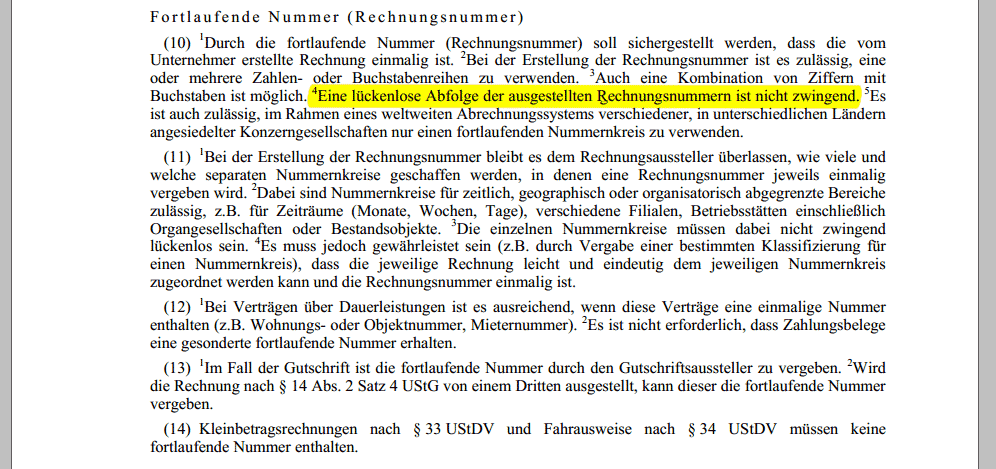 (English image not yet available)
Gaps are acceptable, and it is always good if they are traceable when questioned. In MOCO, any gaps in automatic numbering (e.g., due to deleting an invoice) are perfectly documented, so they are always traceable.
If you constantly have gaps, consider using invoice drafts strategically. In draft status, no invoice number is assigned yet. An invoice only becomes binding with "Create".
A cancellation invoice has the same invoice number as the corresponding invoice.
→ No. A cancellation invoice is an invoice with its own invoice number. It contains the same items and negates the corresponding invoice with the negative total amount.
→ No. The numbering only needs to be sequential*.
Germany requires, according to § 14 Abs. 4 S. 1 Nr. 4 UStG, a sequential invoice numbering. The sequential number (invoice number) ensures that the invoice created by the entrepreneur is unique.
A gapless sequence of these invoice numbers is not mandatory, according to the VAT Application Decree (search for invoice numbers in the document):
(English image not yet available)Gaps are acceptable, and it is always good if they are traceable when questioned. In MOCO, any gaps in automatic numbering (e.g., due to deleting an invoice) are perfectly documented, so they are always traceable.
If you constantly have gaps, consider using invoice drafts strategically. In draft status, no invoice number is assigned yet. An invoice only becomes binding with "Create".
A cancellation invoice has the same invoice number as the corresponding invoice.
→ No. A cancellation invoice is an invoice with its own invoice number. It contains the same items and negates the corresponding invoice with the negative total amount.
The client can see how many invoices I have already issued.
→ It depends. This can easily be avoided.
As a small business, you should not start with number 1, so the client does not immediately see that only a few invoices have been issued so far.
You can freely choose the number you want to start the number range with!
For example, simply start with 30001: RE30001, RE30002, RE30003, etc. Or integrate the year and omit separators. For example, 2000001 (in MOCO {yy}{c} with a minimum width of 4 digits).
→ It depends. This can easily be avoided.
As a small business, you should not start with number 1, so the client does not immediately see that only a few invoices have been issued so far.
You can freely choose the number you want to start the number range with!
For example, simply start with 30001: RE30001, RE30002, RE30003, etc. Or integrate the year and omit separators. For example, 2000001 (in MOCO {yy}{c} with a minimum width of 4 digits).
If I issue an invoice at the beginning of the year for the previous year, it needs the last year's number.
→ No. It usually has no relevance for the tax authorities.
The invoice number is merely a reference point for bookkeeping – what counts is usually the service period of the invoice.
Numbers should contain as much information as possible
→ No. Long numbers can be confusing, especially for small companies. Who likes long numbers anyway... Better to choose a simple system (examples above).
Integrating the complete date is clever.
→ We do not recommend it. Integrating the complete date made sense in the past to guarantee the uniqueness of the number with manual numbering. Integrating the complete date makes the number unnecessarily long and can cause complications if the invoice date is changed later.
→ No. It usually has no relevance for the tax authorities.
The invoice number is merely a reference point for bookkeeping – what counts is usually the service period of the invoice.
Numbers should contain as much information as possible
→ No. Long numbers can be confusing, especially for small companies. Who likes long numbers anyway... Better to choose a simple system (examples above).
Integrating the complete date is clever.
→ We do not recommend it. Integrating the complete date made sense in the past to guarantee the uniqueness of the number with manual numbering. Integrating the complete date makes the number unnecessarily long and can cause complications if the invoice date is changed later.
...............
*Reference Link
The sequential number (invoice number) ensures that
the invoice created by the entrepreneur is unique. When creating the
invoice number, it is permissible to use one or more sequences of numbers or
letters. A combination of digits with
letters is also possible. A gapless sequence of issued
invoice numbers is not mandatory
Nevertheless, even in Switzerland, a formally correct invoice is the simplest form for all parties involved to document the VAT-relevant facts of an exchange of services.
...............
Nevertheless, even in Switzerland, a formally correct invoice is the simplest form for all parties involved to document the VAT-relevant facts of an exchange of services.
...............
NOTE: We provide practical tips in this article – but cannot give legally binding information. Always clarify details or uncertainties with your tax advisor or the tax authorities.