Article from
7 Reasons Why a Sales Funnel is Essential for Acquisition.
Sales, selling, or acquisition – ultimately, it's about winning new projects. But how can this be done most efficiently?
Cold calling in the open field (e.g., trade shows and networking events) isn't for everyone. The uncertainty, lack of direction, and the pressure to approach the right people correctly and say the right thing – almost everyone knows this uneasy feeling. Overcoming it seems to be the key.
There seem to be natural talents who have the knack for being in the right place at the right time, knowing the right people – and then sticking with it until the contract is signed. This brings us to the most important point: Persistence!
With some discipline and diligence, anyone can achieve above-average results.
A so-called Sales Funnel is an indispensable support in this process.
What is a Sales Funnel?
A Sales Funnel is essentially a list of potential new business. In professional jargon, these potential projects or clients are referred to as leads.
Each lead is characterized by the following features:
Each lead is characterized by the following features:
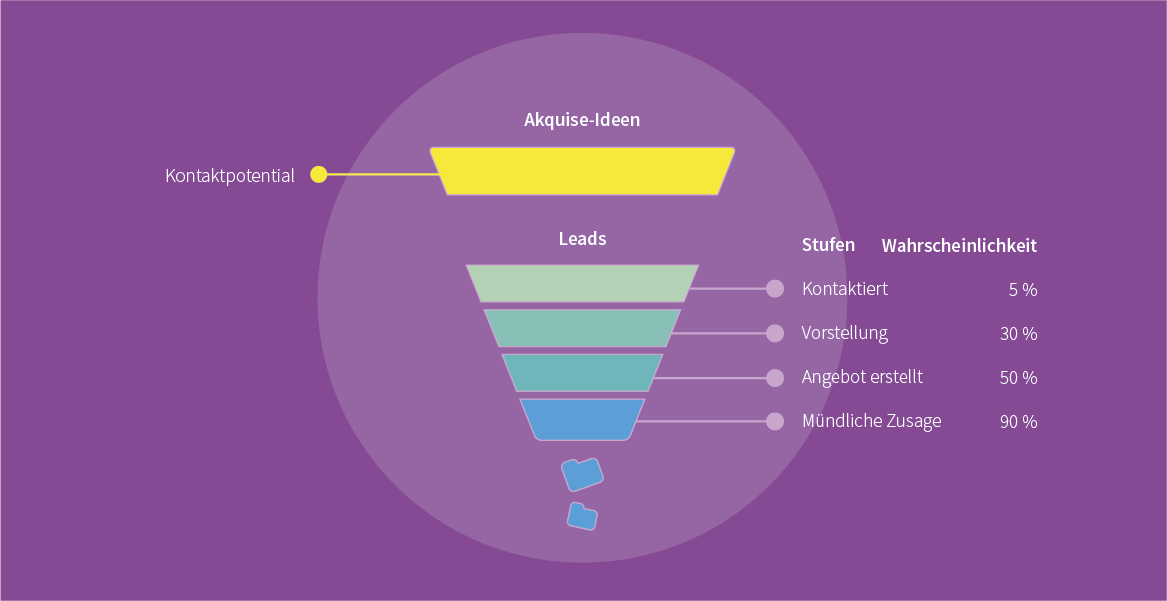
- It is assigned a stage: The stages represent the journey from the first contact to the conclusion. Typically, these are "Initial Contact, Introduction, Proposal, Verbal Commitment"
- There is a history: All information or notes are recorded in chronological order
The translation "Sales Funnel" describes the ideal image of a well-managed Sales Funnel. Ideally, it results in a symbolic funnel shape: Many leads at the top in the early stages with low probability and fewer leads at the bottom with high probability (see illustration).
 (English image not yet available)
Sales Funnel – indispensable for acquisition:
1. It provides clear visibility.
Your acquisition activities are structured and quickly accessible through a Sales Funnel. It also offers business partners a quick and good overview of "what's currently happening." Team members involved in acquisition can quickly orient themselves.
This prevents aimless calling or approaching the same leads repeatedly.
This prevents aimless calling or approaching the same leads repeatedly.
2. The stage and probability of leads become tangible.
Each lead is assigned a stage with a probability of closing. The stages can usually be determined when setting up the Sales Funnel. Let's say a stage is called "Initial Contact" with a 5% probability. Another stage is "Verbal Commitment" with a 90% probability of closing. Depending on the company's size, there are 2-5 more stages in between.
3. Traceability is ensured.
Notes on the steps a lead goes through are recorded. This way, the entire history of the lead is depicted and retrievable. If there are inquiries from business partners or another person takes over lead management in the absence of the lead manager, no questions remain unanswered, and the new order can be seamlessly acquired – and ideally secured.
4. The need for action is clear.
A Sales Funnel is not a dead list but requires regular maintenance. Therefore, a lead is not only assigned a stage but also a date for the next action. The next action usually aims at a renewed contact to advance the acquisition.
Ideally, the system or software reminds you shortly before and on the day of the appointment. Due leads are often visually highlighted. In MOCO, for example, the visible date in the lead list changes from green to orange when the date is exceeded.
After contacting the lead, a next appointment is immediately set to keep the lead in flow.
Ideally, the system or software reminds you shortly before and on the day of the appointment. Due leads are often visually highlighted. In MOCO, for example, the visible date in the lead list changes from green to orange when the date is exceeded.
After contacting the lead, a next appointment is immediately set to keep the lead in flow.
5. You can engage with potential clients on an equal footing.
Potential clients appreciate reliability. Regular, targeted inquiries at appropriate intervals during the acquisition process create a good atmosphere and can help establish a solid trust base.
In practice, it looks like this: If the client is still comparing other proposals, I follow up in 2 weeks. If I send an email, I set the reminder for a week and follow up again. Vague prospects are dated a few months ahead. This way, you don't risk missing important decision points for the client. Regular contact often accelerates the client's decision-making process. However, too frequent contact can be off-putting. You develop a sense for the right timing over time.
In practice, it looks like this: If the client is still comparing other proposals, I follow up in 2 weeks. If I send an email, I set the reminder for a week and follow up again. Vague prospects are dated a few months ahead. This way, you don't risk missing important decision points for the client. Regular contact often accelerates the client's decision-making process. However, too frequent contact can be off-putting. You develop a sense for the right timing over time.
6. Predictions about future new business can be made.
A lead is not just a lead. One project has already been verbally committed, while another doesn't even have an appointment. One has an order volume of 2 days, and another over 100 days. Therefore, it's important to roughly estimate the project volume from the start and enter it into the lead.
By multiplying project volume and probabilities, you get a value across the entire Sales Funnel. This total value serves as a good guide if you want a figure for expected new business.
By multiplying project volume and probabilities, you get a value across the entire Sales Funnel. This total value serves as a good guide if you want a figure for expected new business.
7. The question "Do I need to acquire more or not" is quickly answered.
The target value varies depending on the company's size. It's advisable to always actively seek new leads as soon as the value is significantly below and to limit acquisition activities or seek new staff when the value is significantly above.
Conclusion
Successful salespeople have built a large network over the years and usually have the necessary soft skills. However, anyone can be successful in acquisition with some discipline. With a Sales Funnel, you are well-organized and won't miss any appointments. A quick glance is enough to assess future order situations. The system takes away the anxiety, and a rejection is no longer seen as a defeat. The most important thing is: Keep at it, keep at it, keep at it.
MOCO represents this described Sales Funnel:
In MOCO "Acquisition," leads can be reliably tracked from initial contact to proposal signature. Depending on the assigned stage of the lead, future revenues are predicted with different weightings.
One or more proposals can be created during the acquisition. Once the order is won, it can be converted into a project, and the associated proposals can be invoiced later.
More information on Acquisition & Proposals in MOCO
One or more proposals can be created during the acquisition. Once the order is won, it can be converted into a project, and the associated proposals can be invoiced later.
More information on Acquisition & Proposals in MOCO