Article from
6 Tips for Stress-Free Resource Planning in Project Business
Many project managers still use Gantt charts, MS Project, and Excel to plan their team members. However, these tools often fail to capture the dynamic environment of today's businesses. Software can address this, but the right approach is crucial. Here are 6 tips that guarantee optimal conditions.
1. Embrace Agility
Gantt charts suggest a stability that isn't there. Admittedly, a project plan in the form of a Gantt chart looks professional at first glance. However, it's a misconception to assume that all project details and phases are clear from the start.
Fortunately, agile methodologies are increasingly being adopted. Whether it's SCRUM, Kanban, or XP, the key is to accept that projects are unique, each client has their own vision, and a factory model cannot be applied to services.
2. Avoid Multitasking
We are tempted by multitasking every day. Especially with today's flood of emails and messages, the temptation to get distracted is great. Every interruption, every so-called context switch, negatively impacts our productivity and directly affects quality, revenue, and satisfaction.
We work efficiently when we can focus entirely on one task. Whenever possible, team members should dedicate a full day or more to a larger project. If that's not possible, the fewer projects in a day, the more efficient. Distractions from emails, messages, and the like should be checked only three times a day – this brings calm and focus to the workday.
3. Plan Ahead
Scheduling multiple projects in a day far in advance is theoretically possible – but it doesn't really make sense.
When 4-5 projects are considered in a day, everything initially looks clear and structured. However, the unpredictability of short-term tasks and client-induced shifts quickly show in practice that theory and reality diverge. Tasks planned at the beginning of the week may no longer fit by midweek due to new tasks. Illnesses also cannot be planned.
When 4-5 projects are considered in a day, everything initially looks clear and structured. However, the unpredictability of short-term tasks and client-induced shifts quickly show in practice that theory and reality diverge. Tasks planned at the beginning of the week may no longer fit by midweek due to new tasks. Illnesses also cannot be planned.
As a business owner, it's important to look further ahead and plan for a longer period. 3 to 6 months is ideal to make upcoming capacities and workloads tangible.
4. Plan Roughly
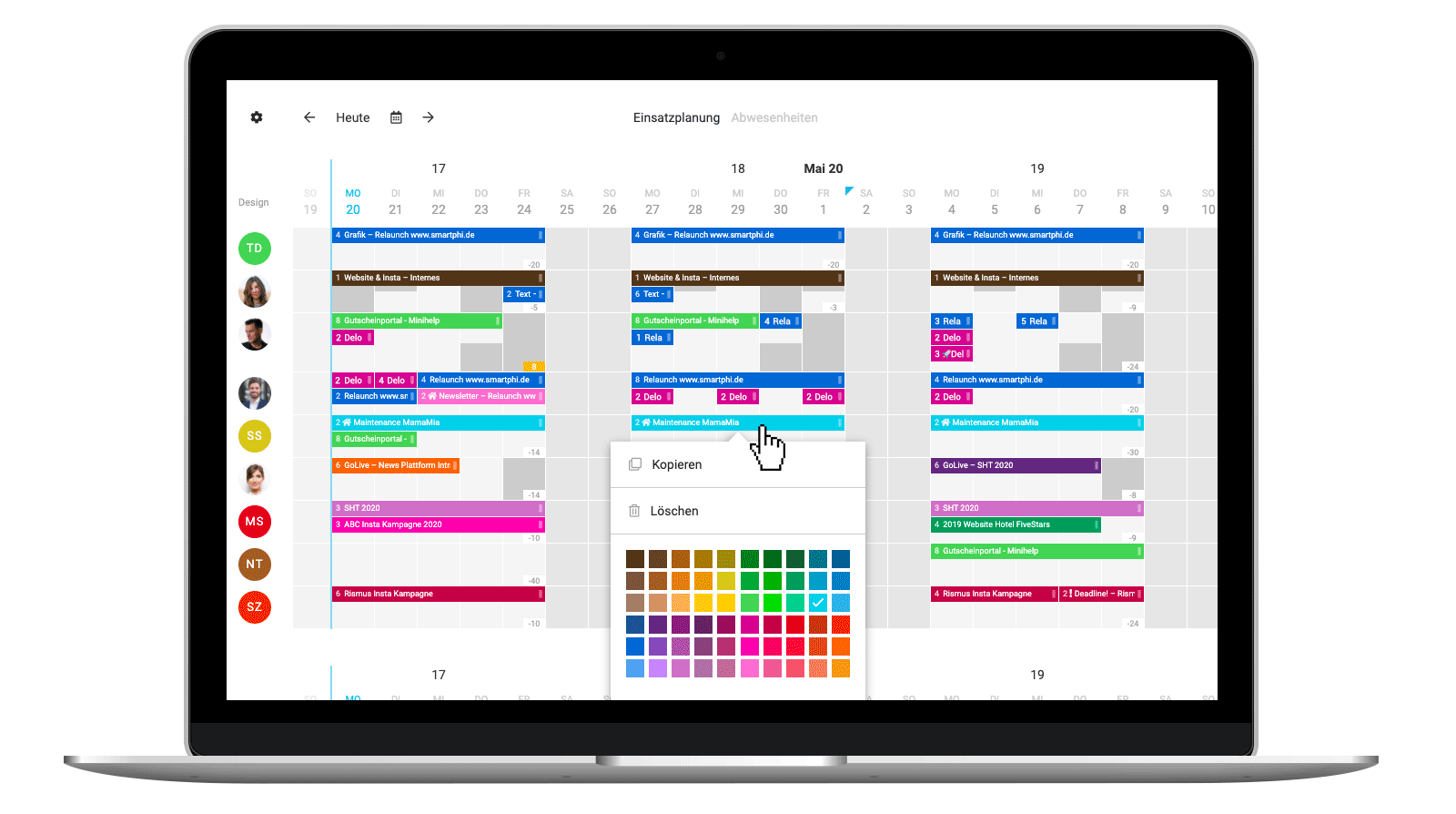
In practice, a detailed daily plan can never be accurate. Although it should always be possible to fit in smaller jobs, this is no reason to plan them. Tight planning gives a false sense of security – missed deadlines and poor client service cannot be managed with tighter planning.
 (English image not yet available)
Ideally, projects are planned roughly. This makes it visible how many people are occupied and for how long, or where there are still capacities. It doesn't matter whether I plan one project per day for 5 weekdays or divide the week into daily slots like 9:00-10:30, 10:45-12:00, etc. From a planning perspective, it amounts to the same by the end of the week.
Rough planning means that in an 8-hour day, only 6-7 hours are scheduled – the remaining time can be used flexibly: for smaller tasks, short-notice meetings, or the scheduled project. It's best to leave it to the employee to use their time flexibly and task-oriented.
5. Establish Client Relationships on Equal Footing
Many service providers like agencies and consultancies see themselves as suppliers always available – even if the client calls on Friday evening expecting results by Monday. This often happens out of fear of losing a contract. Such behavior sabotages forward-looking resource planning.
Developing a partnership with the client on equal footing is essential. A service provider is only taken seriously and appreciated for their work by the client in the long term.
In a partnership-based client relationship, a constructively formulated "No" must also be possible. Clear communication of increased costs for unusually tight timing, early transparency about additional effort, thinking ahead, good listening, and asking questions prevent an imbalance from arising.
If the client can be clearly communicated when a larger new project can start and how long it will approximately take, the service provider is perceived as competent and structured.
"We do everything and immediately" was yesterday. Clients know that a certain specialization brings a higher quality result and have less and less trust in "we can do everything" statements.
6. Discipline Internal Coordination
Completing three projects on the same day – possibly by the same person? If you don't want to burn out your talents and risk quality – which inevitably is the first to suffer – it becomes clear how important coordination is.
The smaller the teams, the less coordination effort is required. Decisions, schedule changes, and absences can be handled quickly and easily.
Resource planning is a working tool that project or team leaders within the company can use to communicate. Task assignments don't happen on the fly, and an assigned team member cannot be withdrawn without coordination with the project leader.
Conclusion
Once we accept that business life is dynamic and stop trying to plan every detail, a new calm sets in. The resulting employee satisfaction and client respect positively shape the work atmosphere and provide the best foundation for outstanding performance and a more stress-free and reliable resource planning.
Article by:
Tobias Miesel
Tobias Miesel