Article from
Cancellation Invoice Instead of Credit Note: The Correct Approach for a Faulty Invoice.
If you want to revoke or correct an invoice, it was previously done with a credit note. The correct approach today is the cancellation invoice. This change is due to the new legal regulation (in Germany*) that credit notes should only be used for "genuine credit notes" and not for the "neutralisation" of invoices.
"Genuine credit notes" are, for example, commission payments. Here, a credit note is a document that represents a money transfer where the recipient does not issue a demand to the debtor, but the debtor proactively initiates a payment. The amount here is a positive figure.
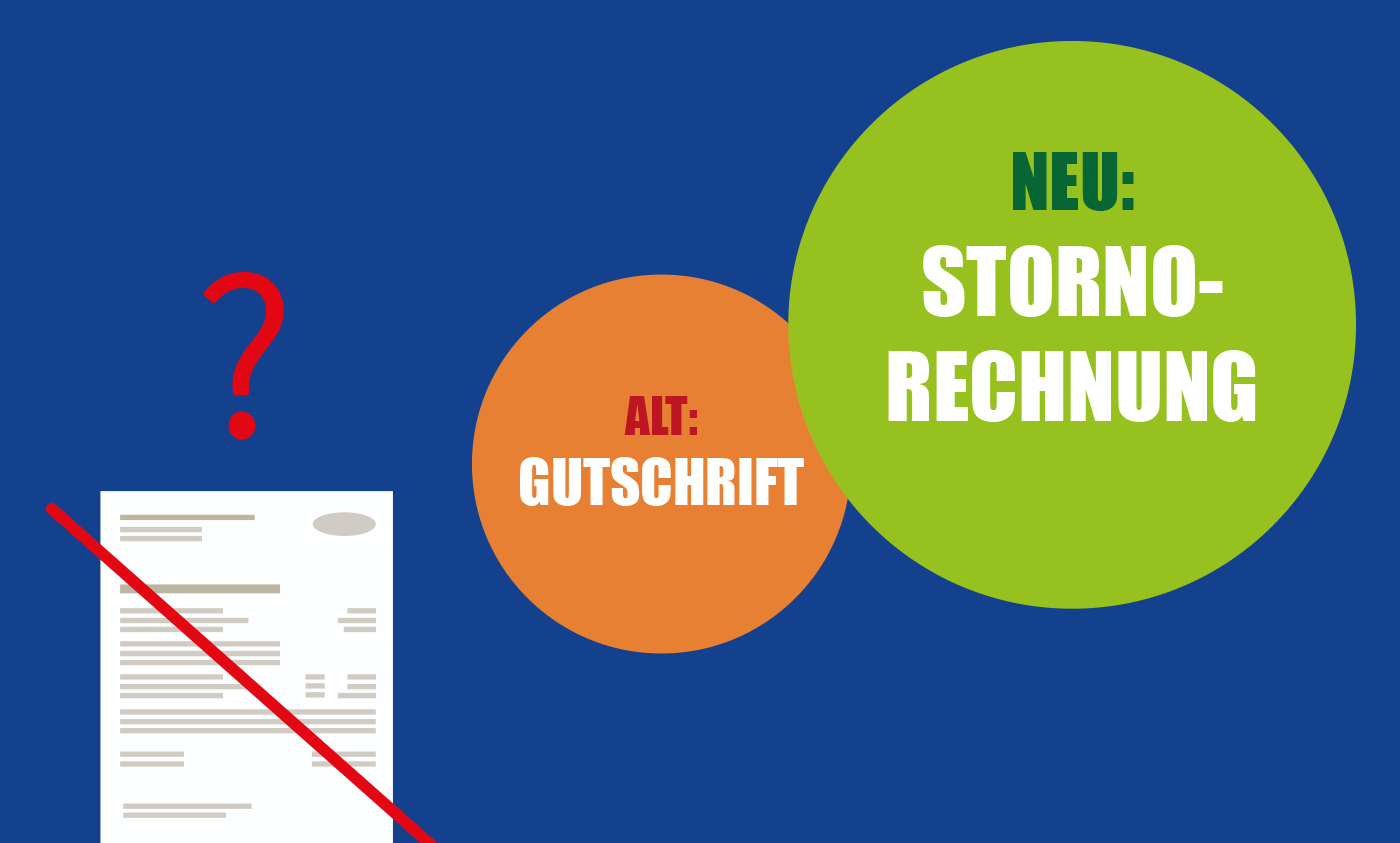 (English image not yet available)
How the neutralisation of an invoice was done before and how it is done today:
Previously
The invoice to be corrected was recorded in accounting as "cancelled" and a credit note was issued. The credit note contained exactly the same items as the invoice and also the exact same positive amount. The title "credit note" was descriptive, and there was usually a note that the amount would be paid out. This credit note was sent to the person who had already received the faulty invoice.
Afterwards, a new invoice was created. This received the next number in the invoice numbering sequence.
Today
For the invoice to be corrected, you create a cancellation invoice.
The Cancellation Invoice
- contains exactly the same items as the invoice and also the same amount - but this is negative.
- has the same service period as the invoice
- receives a new, unique invoice number
- refers to the original invoice (invoice number, date)
- should use the correct terminology. Options include "invoice correction", "corrective invoice", or "cancellation invoice" (not "credit note").
This creates the counterpart to the invoice and "negates" the invoice. This cancellation invoice is sent to the invoice recipient. The sender wants to offset a negative amount with the cancellation invoice - which colloquially corresponds to a credit note. Usually, the recipient has not yet paid the incorrect invoice at this point.
Afterwards, a new invoice with a new invoice number is created, and the invoice recipient only pays this one.
In accounting, the cancellation invoice is then offset against the preceding invoice.
In MOCO, a cancellation invoice can be correctly created with one click at the top right of the invoice using the cancellation action ("thumbs-down icon"). The next invoice number is automatically assigned in this process.
If an invoice created in MOCO is faulty, it can be easily edited and saved again, provided it has not yet been delivered.
* Note:
Legally, a cancellation invoice has been required in Germany since 2013 - in Switzerland, the cancellation invoice is also a correct method, but not strictly required.
* Note:
Legally, a cancellation invoice has been required in Germany since 2013 - in Switzerland, the cancellation invoice is also a correct method, but not strictly required.